Hi All,
Sharing the details about an autism awareness session happened on 28th April 2019. Ooruni Foundation is a Non Profit and Non-Governmental Organization (NGO), you can find more about them from their website http://www.oorunifoundation.com. The awareness session was titled “Children with Autism and Their Challenging Behaviour – An Exclusive Awareness program for Parents with Special Children“.
I personally never heard about them, prior to this event, their website and Facebook showcases the activities they have performed so far and about other upcoming events. It happened in the venue, Indian Society for Training and Development, Chateau D’ Ampa, IVth Floor, No. 37 Nelson Manickam Road, (Behind Sky Walk Mall), Aminjikarai, Chennai – 29. It was scheduled for 9:30 am to 12:00 noon. There was no charges for Entry, it was a free session, however pre-registration was mandatory. Infact they gave Snacks, Beverages and a free book containing 100 working women achievers of 2018-19. Closed to 100 people must have attended the session….
Following people spoke on the session:
- Punitha Thangarajan – Host
- Dr.Renuka Ramakrishnan – President of Rotary Club
- S.Rathinavel Rajan – Founder of Ooruni Foundation
- K.Dhanavendan – Special Education Teacher, NIEPMD (B.Sc., (Zoo), PGDSE (Multiple Disabilities).PGDGC., M.A.,(Soc).,M.A.(Edu)., B.Ed.,(Spl.Edu),M.Ed Spl.Edu(MR), UGC NET Lectureship)
- S.Sobhiya vani – Occupational Therapist , Spl.Teacher(ECSE), NIEPMD (M.O.T)
- Dr. S.Kala – Speech Pathologist and Audiologist NIEPMD (Msc (ASLP), PHD)
- Anandalakshmi – Clinical psychologist, NIEPMD
Renuka Ramakrishnan must have spoken first, as I arrived 20-30 mins late to the session …she was in the middle of her speech already, she spoke the following:
Autism parents and kids live in a world that is special, loving etc. and it is the autistic parents who should allow others (normal parents) to be part of their world to experience the same level of love, affection. Autism kids are only born to parents who can parent them, these parents have heavy heart. Don’t consider this as a Sin/Curse, you are blessed. Special children are externally very happy and has high level of IQ. Find the area of interest, where your kids are focused or has a special ability. Tap the talent at young age.
We explain AUTISM is an abbreviation for ALWAYS UNIQUE TOTALLY INTELLIGENT SOMETIMES MYSTERIOUS. Abdul Kalam spoke in a Conference in Delhi, that “Autism is not a disease”, “They are born to be successful”.
After her speech, welcome gifts were exchanged between Guest Speaks and people part of Ooruni foundation (Charles Lenin, Nagaraju, Selvan I guess)
Dhanavendan spoke next, (he was wearing a suit and has plenty of analogies)
He used the analogy of people going to temples with their issues, to get a solution from god. However they needed priest to be an interpreter/middle man, to make offerings to god and give back blessings to us. Similarly, Autism kids are like GOD, Rehabilitation professionals are priests trying tested and proven practices that help the kids.
He used another analogy, where he mentioned Parents of special kids are owners of a fertile land, children are the seeds and every other process that involves the seeds to blossom for harvest involves facilitators who are these Rehabilitation professionals.
Another analogy, for a tree to grow you need to water it, you think that giving more water will grow it faster and better, so you give plenty of water to it. Similarly another person who is a growing a tree, is giving a less water for the tree. When Cyclone came, the tree that had less water stood the Cyclone, and the tree with more water fell off. Similarly, we should give our kids that is needed irrespective of age, only that and nothing more.
In general everyone has a sensory problem, however for autism kids these sensory problems are more in number. Parents are google scholars, they keep searching about autism every day to find new practices, approaches, therapies that can benefit their children. They are constantly shopping products like assessments, knowledge, awareness etc. With these analogies he finished is initial speech as Shobia Vani, the occupational therapist has the larger content to cover in the session…
Sobhiya vani Occupational Therapist spoke next, (Her part of the session is the biggest portion)
Sensory issues is an ocean, it cannot be covered in an entirety on today’s session, and however she will try to give a brief on important areas. DSM V lays down the diagnostic criteria for Autism Spectrum Disorder (i.e. In 2013, the American Psychiatric Association released the fifth edition of its Diagnostic and Statistical Manual of Mental Disorders (DSM-5). The DSM-5 is now the standard reference that healthcare providers use to diagnose mental and behavioral conditions, including autism, you can refer to online resources for those https://www.autismspeaks.org/dsm-5-criteria)
ASD is found more in Male than female. Autism is a neurobiological disorder. There is no specific Etiology (root causes) for it. Some of the early signs are:
- Poor Imitation Skills
- Abnormality in Eye Contact
- Under responsive to people
- Bland Facial Expressions
- High tolerance to pain or cold or heat
- Hypersensitive to taste, touch etc.
- Lack of Pretend Play
- Poor Joint attention
- Inefficient use of eye gaze
- Communication deficits
- Speech Delay
- Acts as if cannot hear well / ignores
- In their own world
- Repetitive Play
- Unusual play
Common Features of ASD Kids
- Sensory issues
- Difficulty with Generalization
- Over Selectivity
- Splinter Skills (Experts in Statistics, Calendar, Maths, Car names etc.)
Associated Findings are:
1) Clumsiness 2) apraxia 3) Sensory processing difficulties 4) Hypotonia 5) Joint Laxity 6) Toe Walking
Sensory Integration
Our sensory system is constantly and efficiently process information from our environment and our body. Same sensory problem will not be identical to two children. Every child has a different composition. The composition also changes in few months. (Like a seeker may become an avoider). We often take it for granted and don’t realize how difficult it can be for a child. Sensory Challenges can be from any /all of the following senses:
1) Auditory (Hearing)
2) Visual (Sight)
3) Olfactory (Smell)
4) Gustatory (Taste)
5) Vestibular (Movement and Gravity) – It will control our balance and equilibrium.
6) Tactile (Touch) – We would normally feel the pain and decide whether we will be able to tolerate it or not, whereas these kids when they experience pain, the touch(tactile) sensation understands the pain and sends the information to the brain due to issues in modulation, it will turn in to hypersensitivity or sensory seeking behaviors. A Sensation should get registered in the brain in order to get an expected response. They will not react according to the touch, as they cannot modulate the difference between touching a soft cloth and a hard surface. Neurotransmitters are involved the modulation that cause the issue.
7) Proprioception (Heavy work input to joint and muscles) – Every joint in the body has a specific sensation. Everyone in the audience is aware of their body and their joints, hence we are now sitting in a position with knee bent and back straight. For kids who cannot feel the body sensation, they will sit in Awkward Position. To pick up an object they will bend their legs too low to the floor level, since they does not know how much to bend and also to be safe, they bend till the floor level, due to hypersensitivity in the joints.
Classification of sensory disorders
The classification of DSM has changed recently on this, we no longer use the terms hypo or hyper. The types of Sensory processing disorders are:
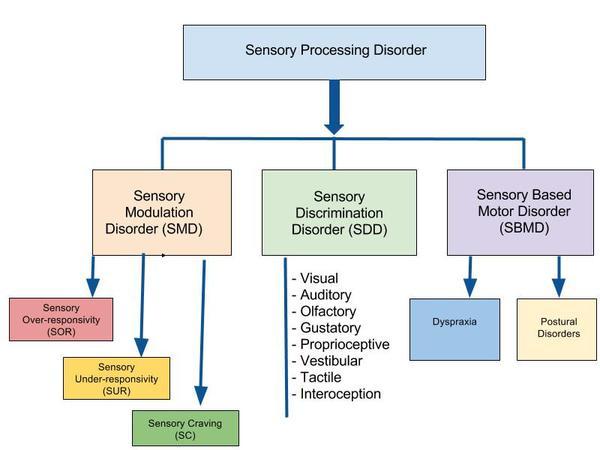
Sensory Modulation Disorder (SMD) Child with Autism has more chances of Sensory Modulation Disorder (SMD)
Sensory Overresponsivity (SOR): It refers to Quick or intense responses to sensory Stimuli. Child does not like the stimuli, as a result they will quickly respond and withdraw.
Sensory Underresponsivity (SUR): It refers to slow response to sensory stimuli. Requires high intensity or increased duration of stimuli to elicit a Behaviour response. The sensation will not register to them, child looks lethargic.
Sensory Craving (SC): It refers to kid’s activity seeking sensation often. They want more sensations on all categories as a result they will rock their body, jump, spin, and chew/eat inedible items.
Sensory Based Motor Disorder (SBMD)
Postural Disorders: Kids fear movement due to inadequate postural control. Transition from one posture to another.
1) Low Muscle Tone (Slumps in Chair, Leans on things)
2) Poor Balance:
- a) Often trips or bumps in to objects
- b) Difficulty with riding a bike or Jumping
3) Poor Stability: Sit in awkward position
4) Head and Eye Stability: Difficulty in reaching for objects.
Dyspraxia: Praxia is the ability to execute non habitual movements. Dyspraxia is the difficulty to execute the non-habitual movement. People with dyspraxia will have writing problems:
- Poor Gross Motor Skills (Jumping and Running)
- Poor Fine Motor Skills (Zipping, Buttoning)
- Problem is figuring out how to do the Movements (dressing and complex dance movements)
For Tactile issues, change Food Pattern, change Food Textures, Deep pressure Touch, use weighted vest, weighted blanket, firm hugs, massage, rough house play, tactile sandwich.
For Visual Accommodating Ideas try: 1) Study Carols and Room Dividers 2) Colored Overlays 3) Bubbles – it is an excellent activity for eye co-ordination. Focus on Play way activities. 4) Playing Catch 5) Visual Stimulating Activity
For Auditory issues, like self-talking make kids use the headphones for listening to mild music. One of the signs of SPD is kids may cover ears for loud sounds, volume, hair dryers, May even start to cry, as it is a sensory overload.
For Vestibular Movements, kids can use therapy balls, air pillow, marching, dancing, rocking, rolling games …Also heavy work objects like Carry heavy books/Toy baskets, Digging in Garden, Work out on weight machine, wheel barrow objects etc. Make use of T Stool, rocking chair, Tennis ball rockers, Trampoline, Swing, Ride on a car, Ride on a bike, etc…Avoid arousal activities before 2 hours of sleep.
For Proprioceptive issues, focus on heavy work activities, tera band, brain gym activities, crawl inside cardboard, try swimming, karate, climbing activities, sand box, cleaning activities.
For Oral issues, use vibrator tooth brush and Oral massage.
SENSORY PLAY
It is important to make kids spend time on sensory play, few such play activities are:
- Try the kids to use a swing made of Rubber Tyre
- Put objects in raw rice and make the kid to search for it and find what it is
- Put old CD’s hanging in the dark room and use Disco lights for visual stimulation
- Use different mat with different textures for the kids to walk, like jute, velvets, cotton etc.
SENSORY DIET
Just like how we eat 3 times a day, sensory needs to be met at regularly. We cannot work effectively, we cannot focus when we do not eat at regular intervals, and similarly sensory activities are required for the kid. Daily intake of sensory and motor experiences are needed by a person to adaptively interact with the environment. Sensory and motor experience help maintaining optimal arousal and attention for learning. Sensory diet formula: Intensity – Duration, Frequency – Rhythm. Sensory diet has to be specific to individual based on assessment. Proper sensory diet will show results in 1 month. Sensory diet will increase arousal and also calming effect.
- Sensory Integration benefits in processing all senses.
- We have not seen improvements on kids due to change in Food pattern.( GAPS diet, GCFC diet).
- All activities given to kids for age 5 and below should be of play way method.
- In foreign, only after 5 years kids are sent to school. This is the age Urine control happens.
Parents Questions:
Q – Someone said that, their kid co-operated nicely in the OT sessions initially, but after 3-5 months, he is now not interested in the activities, he does not co-operate.
A – Kids will master the activities quickly and also will get bored, hence we have to change the activities given to them so that they are interested in performing it. Every 3 months the OT activities needs to be changed. Kids with Autism are in to repetitive behaviors, hence we should not repeat the same activities over and over, and repetition on the same OT activities should be avoided.
Q – Someone asked a question related to touch based sensation of the kid.
A – Try weighted items like lap pads, backpacks and weighted vests. Wrapping stimulates Hypothalamus. This is scientifically tested and proven, that wrapping makes the kid calm and silent. The body generates heat during the wrapping, which generates Hypothalamus, which helps the body to Self-regulate and calm.
Q – Someone asked that their kid has uncontrollable laughs at the night and not during the day?
A – Wrapping can be given, weighted blankets can be worn. Sometimes mild seizures/fits can cause this as well.
Anandalakshmi who is a Clinical psychologist spoke next, (her part was short and good)
She did not have a deck for presentation, she made the audience involved and conducted her session in an interactive manner. The first thing she asked everyone is that “Please tell me about what are the good things about your kids?”, for a moment everyone was silent or confused, as everyone came in a mentality to tell only about their kid’s issues and complain. This question is something not everyone was prepared for, slowly everyone spoke. Also she mentioned not all behaviors are problem behaviors provided they are not harmful and not age appropriate. Do not see every mistake your kid performs with a magnifying glass, treat your child at par with a normal child, else you will not enjoy the parenting which is a beautiful phase.
Just like every other kid goes to a tuition, dance class, music class, singing class, our kids on the spectrum goes to an additional class called therapy, as they needed more effort on that area that is all. If I am short, I use a bench to climb and reach objects kept in heights. There is nothing wrong about it.
She also asked how many of the parents, took the kids to death ceremonies, anniversaries, marriage parties etc… Kids need to observe everything, they learn from the environment. Give them the break at a time duration when a meltdown arises. Not all fearful behaviors are problem behaviors. For Example, if I have fear of lizard and it does not bother my functional aspects, it is not a problem. As long as it does not cause harm to others, does not impact functional activities do not take any action, ignore it.
There are two kinds of Behavior, i.e. Skill Behavior and Problem Behavior
Skill Behavior:
ASD Kids following instructions, highly energetic, follow routines, clean and tidy, high memory, Calendar skills, Learning language quickly, focus, savant skills etc. Some kids have calendar skills, where if you can tell them the year, month and date, they will respond with what day it was. This is a skill which we should not worry about, as long as it does not impact any of his daily activities. Fix a time period for your kid to work on that skill. Savant skills are types of skill that a kid possess without getting trained on it. (Music, Singing etc.)
Problem Behavior:
1) Attention seeking is a problem Behavior. If you have 1 mug of water, and there are two plants, one which is good and another which is gone bad, to which one do you pour it? Attention seeking behaviors needs to be completely ignored, as long as the behaviors are not harmful. Kids do certain things to find out how we react. Children knows how parents behaves like how mom will behave when she is alone, and when the grandparents are at home, and when father is around. If you stop watering the plant, the plant will stop growing, similarly act as if you are smarter than the Kid, and ignore the attention seeking behaviors. At the same time, if the kid’s attention seeking behavior resorts to self-harmful/injurious behaviors, it needs to be addressed.
2) Escape Behavior – In order to escape from the activity that the kid is currently performing, he will urinate purposefully so time is wasted. If this habit continues only during a particular activity, then it could be an escape behavior. Like when you ask him to bring a book, he will bring something else, he will ask for water a lot during homework etc… Let the distraction happen, however do not ignore the core activity, make him do that activity no matter whatever the escape tactics followed by him. This way, kid will realize that he cannot escape from performing that activity, hence such escape behaviors will come down in future.
3) Tangible Behavior – Behaviors are different when mom is around and when grandfather is around. When adamant for a particular object in a shopping mall, do not give in. Say NO clearly (irrespective of price) and do not even attempt to distract. Completely ignore the surroundings, be it the shop keeper, neighbors etc., ignore what they would think about it. Shopkeepers / neighbors are not raising your children, they don’t have the full picture. If your answer to a particular request from kid is NO, it should be NO even after million times the kid asks you. Kids will stop these adamant behavior at one point.
The first three behavior issues that is Attention seeking, Escape Behavior and Tangible Behavior are all man made issues or issues created by parent to the child, it does not come on its own.
4) Skill Deficit – Kids unable to understand the communication
5) Sensory Issues
It is also, important that as parents please take care of yourselves as well, take up hobby, groom well etc.
Sensory needs at Puberty:
Do not ignore masturbation habits. Need to know how to manage appropriate sexual needs at the age of 11. Teach them as to who can touch the private parts. Talk to therapist, how to manage such needs appropriately. These children has high chances of getting in to the child / sexual abuse.
Do not assume that children cannot understand or learn such instructions, they have the ability to learn it. Not all autism kids have disabled intelligence.
Parents Questions:
Q – Child does not likes to go to beach
A – Sensitize your child before taking out to mall or beach. Tell him that we are going to mall, you have to be good, etc. For a child who does not like going to beach, before going to beach prepare the kid mentally … use pictures of sand, water, ships to know that to expect by the kid. Carry these pictures along with you to the beach and show him what is real and reel.
Q – Kids says that mom is boring
A – This happens to kids who watch too much TV and spends too much time on Phone. Kids find the electronic gadgets stimulating, hence they find others things that does not have stimulation as boring. (There was a suggestion from Dhanavendan asking if mom puts on a lipstick, kid will observe the mom more, as the lipstick color will be visually stimulating to them)
Q – Kid is hurting others
A – If the kid is hurting others, it means that kid is learning from parents. When they hit the child when they are angry, kid does the same. Kid is learning everything from their parents.
Q – What is the ideal period to wait, before changing therapists?
A – 2-3 months is the ideal time period for a therapist to get know about the kid and understand his/her behavior, you can see changes around that time in the kid as the therapy would take its effect. Today world, all parents are doctor shopping, i.e. they change therapist in a short span of time, before the therapists understands the kid. If Parents keep doing this, when will they begin their intervention?
Q – Kid does not like being in the mall for longer time, he cannot stand beyond 30-45 minutes?
A – Some kids will not like some atmosphere, hence do not compel if that is not preventing his learning ability. In other cases, you gradually increase the tolerance limit for 30 minutes to 40 minutes, and 40 to 50, etc.
Q – My kid is hitting others
A – If the kids are hitting other kids, from where are they learning that behavior? It is clearly learnt from parents most of the time. If you beat your kids when things did not happen your way, kids does this to others during such situation. If you should at them, they will shout … If you hit at them, they will hit back as well.
As a parent we focus on problem behaviors instead of Skill behaviors. If you focus on problem behaviors we are focusing on negative aspects, the more you focus more problem behaviors will grow. For example, if your kid plays with a neighbor kid, will you say anything? NO Right..! Similarly if your kid beats up the neighbor kid, will you not try to control/attend the kid? So kid observes and understands that mom/dad will provide their attention only if i beat up other kids and not by playing with them … Got the Logic!
1. Emotionally these kids are nowhere different from normal kids 2. Sleep disturbance if not addressed can be developed in to mental illness. 3. Do not load all our expectations, dreams on to the kids.
Rathinavel Rajan spoke the following:
The autism project is titled as “Give Their World“, autism kids live in a world that is loaded with happiness and fun, there is nothing else in that world. We have to give them their world, they deserve. We are dumping the kids with our dreams, ideas etc… stop doing that.
Every year Freedom Carnival happens on Aug 15th for autism kids, this is purely for our kids free of cost, please bring your kids, enjoy the time and be happy. This year (2019) the venue is not yet finalized, we might finalize on Panimalar College, poonamalle, which is tentative as of now. Last year it was in Annai Velankani school, prior to that it happened in NIPEMD.
It has games, counselling sessions, different diagnosis methods, medical practitioners are going to be invited. We are also going to arrange transportation from cities…. Please bring your kids and go back with happiness … no cost involved …Ooruni also does another awareness called Aware, which is for women … The book contains stories of successful women, it contains pictures of the freedom carnival happened last time.
Also there is an aspiration to begin a music band with special kids. Every kid has a talent. Also encourage that. He thanked all the participants for investing their time on this session. They are doing such a session for 3rd time now.
S.Kala who is a Speech therapist spoke next, her deck titled as “Overview of communication disorder in Autism Spectrum Disorder”
Parents who comes to speech therapist will simply state that their kid is not speaking. ASD is the language disorder, it is not a speech disorder. They are listening, but they are not understanding our language.
Communication is Language, Speaking, Understanding, Listen and Reciprocate or Reproduce put together. Without Speech and language you can communicate i.e. NON verbal communication, communicate using gestures, Pointing Fingers, Pull the hand, body language, sign language.
Modes of communication we use are Hearing, Visual, Taste and Smell.
Communication is an observed and learnt behavior. Without speech and Language, verbal communication will not be there. They will not understand what you are saying, instead of understanding they will simply repeat what you are saying to them i.e. Echolalia
For a kid who is nonverbal, we should first focus on Pre-linguistic skills before teaching to speak. Without these skills, your kid cannot learn to speak. Pre Linguistic Skills are: Attention, Eye contact, Listening, Concentration, Turn Taking, Imitation, Object Permanence etc.
Object Permanence: A normal kid, if he is playing with a toy in the morning, when school time arrives, he leaves the toy at home and left to school. When the schools ends, he returns to the house he will pick up the same toy and continue playing like he did in the morning. Whereas an autism child, will simply play with another/different toy after returning from school. If object permanence is developed, speech will come faster.
Speech is produced using:
1) Respiratory System 2) Phonatory System 3) Articulatory System (they like to eat crunchy chips a lot) 4) Resonatory System.
All the above systems in correlation with CNS, produces the speech. CNS cannot be addressed by medicine.
Communication is classified as Receptive (ability to understand) and Expressive (ability to express). Receptive Communication are: Eye Contact, Listen, Concentrate continuously, Focus, Turn Taking and Vocalization.
Understanding by the kid is important. The RLA (Receptive Language age) and ELA (Expressive language age) should be age appropriate. Assess your kid and find the base line i.e. the current RLA and ELA age so that a plan can be worked upon and therapy can be given. For example a kid who is 5 years old, might have an ELA of 2 year old and RLA of 3 year old. They will have a very limited vocabulary.
It is common that there will be no friends for autistic kids. Normal kids will refuse / does not co-operate to play with autistic kids, due to their lack of socializing behaviors. Social communication includes: Use of Gaze, Joint attention, Initiate of communications, sharing affect, play behaviors, use of gestures and social reciprocity.
We need shape the kid for the above, by sensory integration, group therapy, behavior intervention, before teaching to speak. Group therapy helps in socializing, taking turns and imitate others.
Language and Related Cognitive skills:
1) Impaired acquisition of words, word combination – Child loses/forgets words previously acquired
2) Use and understanding of nonverbal and Verbal communication –
> Facial expressions and Body Language
> Receptive language appears more delayed than expression
Speech chain involves: Speech encodes idea > Speakers motor activity > sound waves > listener’s ear > Listener Decodes.
Linguistic Skills involves Modelling, Commenting, Expansion, Sentence completion, Questions and Categorization
Speech and Language Strategies:
- As parents, you have access to your kid 24 hours, have constant interaction with your kid. Parent Child interaction is very important.
- Child must lead always. OWL i.e. Observe, Wait and Listen. Child must initiate an activity you simply observe, if he is struggling to perform it, do not help wait till he completes it and listen to him.
- Pre – Verbal Skills
- Sentence Completion
We only learnt that by going to homeo, siddha, horse therapy, music therapy, aqua therapy etc. all of it does not work effectively. You will see changes for the first few days/weeks, but there will be no considerable improvement beyond that time.
Parents who are sending their kids to speech therapy for the first time are totally impatient and expect results in a week or after one or two sessions, and begin their complaining mode and change therapy centers. There is a lot of work that needs to happen before teaching the kids to speak. Trust and patience is required.
Dhanavendan spoke finally, we were running out of time, hence he rushed the slides (but still had time for analogies).
Kids must be prepared for the learning environment. He should be trained for different types of learning that he is going to be exposed in the Inclusive schools. He began with different analogies, not worth mentioning. Active learning and Experiential Learning is most important.
There used to be huddle, hug, pressure, overload, pushing within siblings earlier, which is absent, the sensory load that was addressed naturally was left behind. Movement is important. Motion Types are up and down, circular, linear, and vertical, everything must be experienced. This should be given to kids.
For example,
Kids used to make their own swing using rope to play by themselves, after building a rope swing they would try it out and find that it is painful and not comfortable. So kid uses a soft base for sitting on it, like a plywood or cloth or cushion and then plays the swing, this is adaption and using his mind.
Similarly activities like hugging, pushing, playing on Palm/coconut tree leaf stalk (Thennai olai mattai) where one person sits on it and other pulls it etc. are missed out on.
There is a vestibular sense, when you travel up and down on the bridge.
Blooms taxonomy is important, we should make the kids understand. Simply making the kids to speak words is not enough. Sorting, Matching, Identification, Categorization / Generalization all has to happen. We need to give opportunities to kid to learn areas where he is lacking the most.
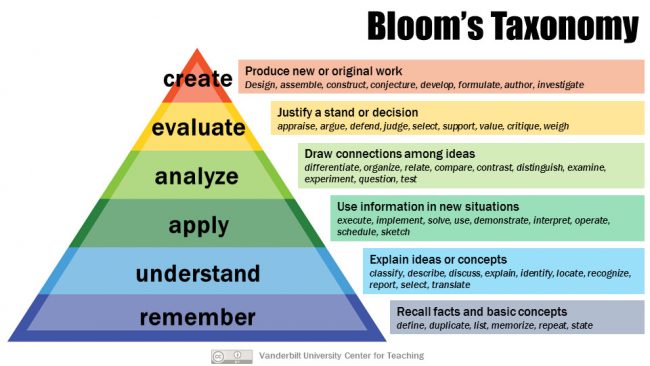
The important aspects such as Listen, Attention and Concentration are lacking, we need to build all the above. Make them fluent and make it consistent. Context needs to be explained to the kids in advance to be mentally aware. Build a story, that way the words are familiar to them, they keep remembering it…
For example, if you are planning to travel by train with kid, begin like …” 6 pm cab will arrive, we will travel on cab with our luggage to the railway station, after reaching railway station, we will get in to our train with luggage, you have to sit with mom all the time inside the train, you should not touch others, you should not accept anything that is given by others, you should be a good boy, then we will reach grandmother’s house …..”
Instead of taking time to do the above, we are simply pushing and pulling the kid without giving him a chance to understand / observe etc.
If your kid does not write, before teaching him how to write, we should teach Pre-writing skills. Pre-Writing skills are coloring, drawing etc. …and to perform drawing, the kid must have seen many pictures so that he could recollect it from the brain to make that drawing.
Below are few models and concepts he shared in his slides:
- Information processing model – Gagne et al 1984 – http://members.aect.org/edtech/ed1/18/18-03.html
- Social Learning Theory (Bandura) – https://www.learning-theories.com/social-learning-theory-bandura.html
- Edgar Dale’s Cone of Experience – http://www.vkmaheshwari.com/WP/?p=2332
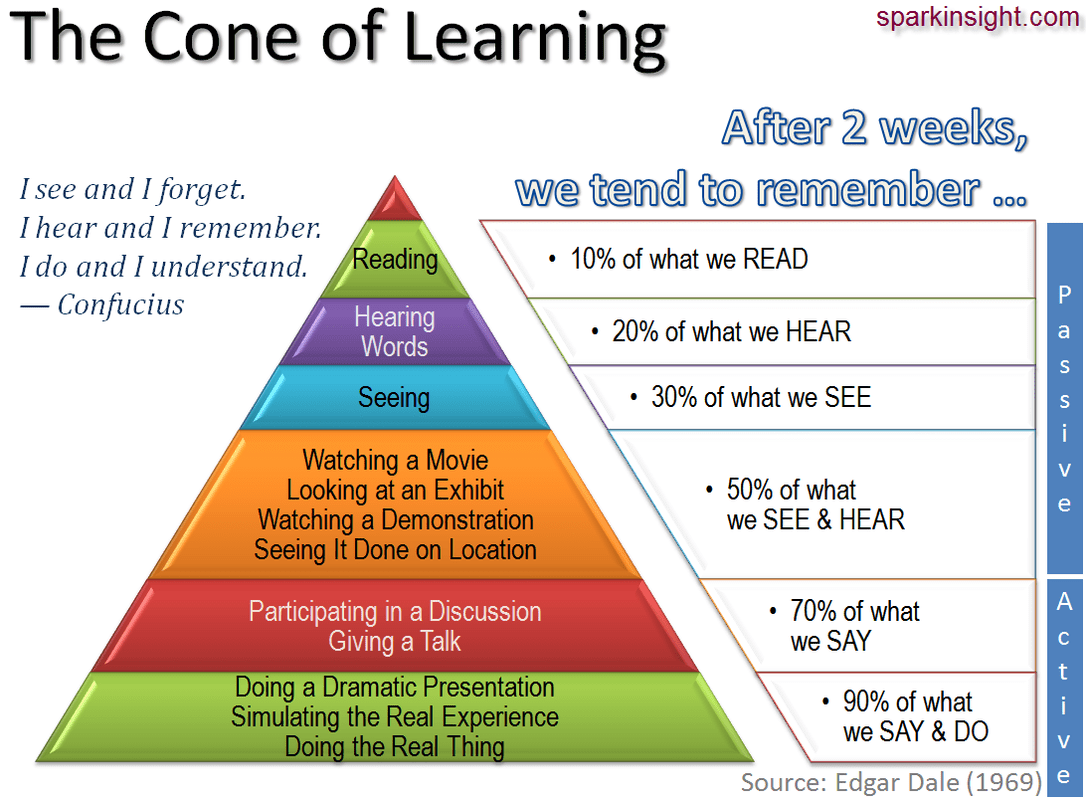
When requesting your child for performing an action and you promise them to deliver a reward / reinforcement give them as promised. It will motivate the child to perform better.
Guided Learning has following components:
- Principles of Universal Design Learning (UDL) (Refers to inclusive class rooms)
- Equitable Use
- Flexible in Use
- Simple and Intuitive use
- Perception Information
- Tolerance
- Low Physical effect
Multiple means of representation, refers to representation of a same concept in multiple ways. Use videos, pictures, other materials to make the kid understand. Also teach them to express back. If not writing in the classroom, focus on others like vary special arts. (sports, yoga etc ..). Skating is one such activity that helps in arousal.
Savings in the name of child is must. Nobody in the world will take care of your child, without money.
We get lot of illness, but by God’s grace, these children do not get diagnosed with any illness that are severe or life threatening from my experience of 23 years of handling disabled children.
Your kid is a reflection of you, your are doing well in all areas, your replication can never have the fault, he will have the traits/behaviors/mannerisms you might have had some point of your life…. nothing new would be there.. Save for the child and stop spending for the child.
You can go for Village tour, make the kids walk in grass fields, muddy fields etc. NIEPMD is offering diploma and many other courses. Also Care giving courses for parents. The fee charged by them is nominal and it’s based on the salary of the parent. It has received awards for its service, as a parent you should try our services and judge based on it.
Some parent raised a concern that it is extremely difficult to bring the kid to NIEPMD due to the distance, there are kids who does not co-operate on longer travels.
They kept repeating over and over that whatever suggestion given during the session was a generic one, hence consult an OT/Speech/Psychologist for assessment before following any of the activities.
My personal feedback on the awareness session is that:
- Mic should have been used, the voice was not audible all the way till the end.
- Audience co-operation was kind of lost its way, they lost patience and began asking questions interrupting the session flow
- Most of the parents did not understand the difference between a session and a consultation. They were looking for answers to the issues faced by their kid, grandson etc. on a public forum and expect the therapist to provide answers.
- Thank the therapists for devoting their time on a Sunday for delivering the session.
(i recollect seeing couple of faces from SCAN Network in the session …)
There was a Q&A session that happened finally, but it did not happen in an organized manner, hence i decided to leave at that point of time.
Regards,
Saranya and Karthik
karthiksaranyaparents@gmail.com
Disclaimer: All the pictures are taken from google searches.
 Autism Spectrum Disorder - Personal Experiences (Chennai Family)