Hi All,
Alpha to Omega Learning Center and St Johns Public School had an awareness program on learning difficulties last month (that much time i take to write a post !), sharing the details of the same. Session details are:
Specific learning difficulties and Creating a holistic inclusive school
Guest Speakers
1) Dr.Sultan Ahmed Ismail Ph.D. D.Sc, Director Ecoscience Research foundation, Chennai
2) Dr.Ritu Malhotra Ritu, Psychologist
3) Dr.T.T.Srinath , Organizational and behavior consultant
4) Ms.Lalitha Ramanujan and Team, Alpha to Omega Learning Center
Sunday 16th June 9:30 am to 12:30 pm ..
Venue – Adonai Auditorium, St Johns public school, lake bund road, Jalladianpet, medavakkam, chennai 600100. You can visit alphatoomega.org for further details on them. The session was free of cost, refreshments and lunch was offered. I arrived late for the session, the session was already in progress.
Welcome address was given by Ms.Lalitha Ramanujam. She mentioned that our children are doing academically well, even though they are not aiming at 100% pass out as it was not their mission, she clarified that her mission is building a change in the child so that they are holistically developed well adjusted citizen for the country and doing well. She also mentioned last year 99% of their kids (excluding 1) has cleared their 10 and 12th examinations.
First Part of the Session
First session (probably the best of all), was delivered by Dr.Sultan Ahmed Ismail which is on “Parental Nurturing“. The host began the introduction about him, he simply walked to her, snatched the mike and said that is enough and began his speech! He is in teaching profession since 1974 for the love and passion of it. He mentioned his Grand daughter is a slow learner, hence he can understand and relate to the problems that are faced by other parents as well. You can find many of his talks in youtube (search for Sultan Ahmed Ismail), he seems to be a big deal ..! I sincerely request all the parents support groups, forums, schools should invite him and listen to him. I was disappointed that his session was for only 45 minutes, one could listen to him all day. He spoke with mix of English and Tamil as the audience were a mixed bag, he had a good command over both the languages, very clear and bold. He mentioned humorously, soon we will have “Grand parents Nurturing” as grand parents and grand children have a common
enemy!
He had a heavily loaded deck for presentation, before showing the slides her clearly mentioned that some of the video clips that would be shown here might have been seen by others earlier, in which case please MYOB i.e. Mind your own business, and do not
disturb others (telling what would happen next in the video).
You are going to teach your children, the mirror image of the word teach is Learn. It is only by teaching we start learning in our life. Do you talk to your children at home or Do you teach your children at home ? Most of them replied, they talk to their children, but as parents you expect them to learn from you talking to them! When i talk to my children they listen, but when i teach they learn. When they listen they remember, when they learn they don’t forget. It all starts from what we are trying to communicate with people, are we trying to teach them or we are trying to talk to them. Makes a lot of difference. When you are serious with the children, you teach them as to what is required, and not simply talk to them which is inefficient, and for that we must start thinking differently. The physiologist in the world recognizes that by holding children like these (refer pics below), improves the vestibular movement of the child, that makes brilliant children. Which we have been doing many years ago


The problem today is that many parents giving more importance to something else other than the child. It can be a phone, it can be an i pad, it can be a kitty party, it can be a television, etc. This child right from an younger age, starts feeling displeasure and this displeasure is reflected because when you live with the child and talk to the child, it is a 3 dimensional activity, you are nodding the head, you are talking to the child, you are getting the response, whereas today you are putting your kid in front of the TV and saying don’t disturb me as long as i am working. When you are having breakfast, you put TV for your kid, as long as you are not disturbed you are happy. When this happens, this completely destroys the 3 dimensional creativity in the children. When this continuous to go on, your child starts mimicking what happens in the television. The television starts molding the brain of the child rather than you. Today more animals are taking more care of the children than human beings!
He showed clips where child stops crying when given the phone and began crying when the phone is taken out of his hand. The attitude starts developing from there for the child. You enjoy what child does with it at that point of time, you will not realize what impact it is going to have once he/she grows up. According to Cascade (he was referring a firm run by his friend i guess), most of the kids who comes to them with these problems are those who have been exposed to the small screen when they were a small child. We as adults are doing the same thing ourselves, the moment you go the restaurant, the first thing you do, is to take the picture in your mobile and post it in some platform. When this sort of situation has taken over, we should change our communication balance.
My intention of coming today is to communicate to you, i can talk as along as i get your attention. When the child approaches you, it will also approach you with an intention to talk to you and the child would love to talk to you, only if the child gets your attention. If you don’t give your attention, the intention of the child to talk to you completely goes away. The most important organ for the parent, you must have is the big EAR …do you have it ? Now a days our mouth is working more than our ear i.e. we are communicating with out listening well. We have to change this.
As a parent how much time do i give to listen to the child, rather than to talk to the child. Many times the child may come to you, to talk to you about with lot of information, because you have no time for them, they don’t say anything. Can we spare more time for them. At home start asking open ended questions. If you ask a question to your child “Did you like the movie?” the response can only be a YES or a NO. If you ask How did you like the movie? the child will begin to open up and express. As far as possible, try to design open ended questions, so the child starts talking, expressing, and please appreciate your child. Please appreciate children even when they are able to do a small things.
Communication is very important. Your voice, what you do with your children is very important. Always before you talk, connect your brain to your tongue, don’t make statements as such. Please teach your children on how to think and NOT what to think, it is very important. In this situation what happens is that, we as grown up adults have a squared way of thinking, as we have seen the world and things already. A Child comes with a circle way of thinking. Circular thinking means it is limitless there are no corners to it. Since we are experienced, we have made a square and we want to convert the child in to that square, not only the parents even the teachers and/or system i.e. syllabus is square but the child is circle which never matches, can we try to mold the system as
well, as we move forward.
Now the child is exposed to different subjects. For example mathematics, which i never understood till date. Every body need not be successful in every other subject, it is not possible at all. When we say H2o child understands it as H to O. We have to bring the
brain balance. Teaching through book will not make every thing understandable for a child, in fact we never understood anything by studying from book. He showed an example of a simple math problem, as most of us are weak in that area. (and some how we want our kids to be brilliant mathematicians)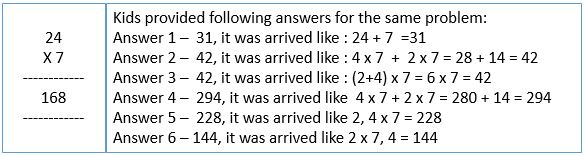
A child can bring so many answers, he gave so many examples, i remembered only few . According to the child all these answers are correct. Ask the child, how did you get this answer and ask for explanation. Don’t tell them they are wrong, as our children are
already going through stress. When the kids explain to you, tell them that it is right and justified according to their explanation, however you clarify that mathematically this is what you are supposed to do.
We are Indians, we did not come from Britain, our mother tongue is not English however we force every kid to read English. Also, Never correct a child before he/she finishes the sentence. How many parents when teaching their kid, explain the concepts using models. We don’t have time ! You can speak any amount of time to the kid, however for the kid there are two times i.e. prime time and down time. Every Child has
1) Prime time – this is the time when the child can concentrate i.e. learning time
2) Down time – this is the time when the child looses the concentration. We Shout at the child during that time, don’t shout at the child , entertain the child at that time
This is the reason why you see a comedy scene comes in between on a movie, so that the down time is taken care of and audience is kept active and entertained. The typical focus/patience Time is Age + 2 mins For example, 6 year old will have 8 mins patience …a 25 year old will have 27 minutes of patience. You want the kid with 8 minutes of patience to tune in to your 27 mins of patience, which is not possible. This is the problem everyone is doing. We have to adjust to meet the child’s needs and not adjust the child to meet our needs.
Natural order is Listening, Speaking, Reading and then writing. The above order is not followed by parents now. The moment the child is born and given to you by the doctor, he will snap in kids ears, and confirm child is normal. The first sensory organ that starts working is your hearing/ listening ability. When one fine day the child says amma, that is the second stage, third is reading and only the 4th is writing. But we are not following that order we want to update the child to write immediately.
He mentioned English is a funny language and you need to teach it differently and he gave few examples on the same:
1) NOSES SMELL is a normal expression, but during rainy season NOSES RUN.
2) For the word Ma “rr” ied, we don’t stress the R that much as there are two of them in the word. But as per kid, he will try to put extra as there are two R’s in it. In which case you can teach the kid that, when you marry it will be two people hence there are two R’s in it.
3) For the word Bu “r” ied, we stress a lot on the R sound as if there were more than one it it. A Kid will try to pronounce with a single R in it. In which case you can teach the kid that, when you bury you normally bury a single person, hence there is a single R in it .. As mentioned above, come out with Suggestions, this is what is expected from today’s parents. Make stories, create conversation.
A Plural for Mouse is Mice, similarly Plural for Louse is Lice … whereas Plural for House is NOT HICE, it is Houses. Tell them the rules of the language first, then teach exceptions separately . Don’t try to teach the exceptions at the beginning, it confuses the kid to learn the pattern, will resist the learning process totally.
It is always “I before E, except after C” is a rule for English spelling. For example words like QUIET, PIECE, FIELD, BELIEVE, etc
you see letter “I” comes before the letter “E”, so it is easy for the kids to remember when learning spellings. However there are exceptions which you teach later, for example words like Weight, Weird,etc. you can see that E comes before I, hence these are an
exception.
Now to teach a difficult word , you can break the word in to smaller words and teach the kid like a story. For example a word like Assassination can be taught as shown below:
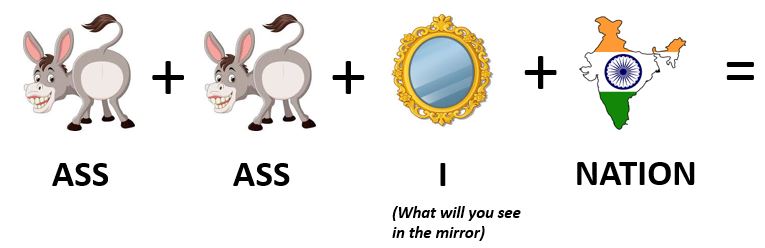
Please concentrate on this, when you are speaking with your child, do you discuss with your child or do you argue with your child.
- Discussion focuses on What is right
- Argument focuses on Who is Right .. which creates a problem ….

Can you find the the mistake in the above picture ? every one read it as “Can you find the mistake”, whereas there were two the’s in the sentence. As a parent when you are allowed to do mistakes, why do you expect the kid not to so the same. One short circuit, the child is labeled disabled. Never beat the Child, don’t emotionally abuse.
Parents mistakes are:
1) Bring up a child as we want to
2) Instead of enjoying the Summer vacation, sending the kids to the Summer camp
3) Asian children should become a Doctor, engineer or computer Professional, else it is an disgraceetc …
He also shared few riddles, which were quite interesting, sharing couple of those below:
1) KEN EDY
Answer: Kennedy Space Center
2) What falls but never breaks and what breaks but never falls
Answer: Night and day
Make a Change from “A” parent to “The” Parent. Umbrella cannot stop rain, however it will safeguard. When Plan A fails, remember to come up with Plan B,C…Z. Shed your Ego.
He advised on following food habits:
1) Follow our Indian Flag Tricolor (Orange, White and Green), i.e. eats carrots, milk and lots of Green Color Vegetables.
2) Avoid any food that has a TV Commercial.
3) For Probiotics please eat Curd + Pazhaya satham.
We have lot of labels now, AHD, ADHD, SPD, HYPER, DYSLAXIA, DYSPRAXIA etc …., it is very easy to stick one such label to any of the kid. Remember this, we were not assessed at your younger age, if we were to be assessed during our child age, we will also be labelled with more than one such labels available now.
His contact details are:
93848 98358
sultanismail@gmail.com
http://www.erfindia.org
sultanahmedismail.wordpress.com
simpletasksgreatconcepts.wordpress.com
2nd Part of the session on the Emotional Stress effect on Learning.
Session was taken by Ritu Malhotra, she is a psychologist, a kinesiologist working with stress-related imbalances and is a teaching Metaphysician. She runs the center AJNA, which was named after the Third Chakra in Kundalini it means perception/conscience. Her website is https://ajnacenter.org. She began her speech asking every participant to take a Deep breath, scientifically it helps in shifting the brain hemispheres.
The feeling of Emotion begins from moms womb i.e. when we take birth to the womb, when conceived.The first learning experiences begin from there, we become whatever our mother is feeling at that time. How her world becomes ours, her feelings becomes ours. We have complete ESP Extra sensory perception at that time, when we are in the womb. We are aware what gender we are. Reaction to the birth also we feel, all this is done through emotions. This is how our cellular memory beings to start, everything we eat, see, feel is recorded in the cells.
Example: Say you are 2 years old, and you are playing with kitten, cat now scratches you, the touch, color, fur of the cat is recorded in your cellular memory. Now we are 25 years old, and we see a cat, we recollect of the big scar and we might have a negative reaction to it or an allergy, the brain remembers everything that has happened. It brings that up when such a situation happen again. That is how we develop cellular memory.
From the moment of conception to 7 years, Emotions recorded in Cellular memory help one to make image for yourselves, it will be like a box around us. Say, if we are told that we cannot do something, say we cannot ride a bike or play a sport, that becomes the
image for us. From then on, we don’t remember when we made this image, it becomes like a little box. Kids feel stress as much as we do. As kids are watching us, our stress gets conveyed to them. We share what we feel, as emotion is an energy. If we are angry,
they watch us and they become angry. Also the way we are angry, if we are violently angry they learn that as well from us. If we lie and tell the child not to lie, we are passing the message that it is ok to lie. For instance, if phone rings, you ask the child to pick the phone, tell that you are not available, these things confuses the child.
How do we learn and address these issues which we hardly talk about. We Focus on the deep impressions that made to us during our childhood. Our brain and body from then on, behaves subconsciously on the same manner what we did then. All a child really does is to learn how to survive in a stressful or a learning situation. If in that learning situation, he has learned to lie or to cry or to runaway or to fight or to fall sick, then he will continue to do that for his rest of his life. This child has no other way to deal with it. But as a grown up too, we find we are doing the same things, no body told us we have a choice.
My work some times called as “Bloodless brain surgery”, what we really doing is we are identifying moments where we made these choices that has become such deep impressions in the brain and learn on how to disengage from the hurt, pain and fear that we have.
There are 3 basic things that we all function from:
1) Fear 2) Pain 3) Fear of Pain …
Fear and Pain we can manage, we will get used to it, but if i tell you that tomorrow at 3′ o clock you are going to break your leg.
It is the fear of pain that one cannot handle, in same way if i am approaching something that is going to hurt me, what would i do? wouldn’t i avoid it, completely deny it ? my work deals with stress of that situation.
Learning is not just academic learning. It is important that we discover the choices that already exist within us and appreciate in our life. Acceptance is the very very powerful antidote to stress. When we resist accepting something in our life which is a reality, its
like we are swimming upstream. It is going to be very difficult, takes up lot of effort on our part and we may not be able to do that. So we cannot win by opposing a reality that is there in our lives. Accepting a reality does not mean that we resign, that we
give up, become helpless. Acceptance is anything but passive. Like resignation, we have given up, its our choice. In my work, these no choice situations are the choice that we make, because life always gives us the choice. A Choice that exists within us, we need
to discover it, we need to find it, may be not by ourselves , some one else can help us to do that. But that would be a truly liberating thing to do.
Acceptance is a movement, it means that we are willing to move away from feeling burdened. Acceptance means optimistic, to find the bright side, to be open to accepting new idea’s to trust that, if this is coming my way then there is something else as well, lets find that. To be creative (i.e. Give myself another choice to do it differently) and most of all, to have the gratitude if it wasn’t for this, i would not have learnt it, i will not be creative as i mean to be, there is a win in every situation. Life never gives us any situation that we don’t have a courage to handle. There is a win in every challenge, it is our responsibility, through our acceptance we have to find that.
Few parents shared their experiences, with that the session concluded with everyone giving a pat on our back by ourselves.
3rd Part of the session was taken by T.T.Srinath
T.T.Srinath has spent over 31 years as an entrepreneur and 25 years as a programme
facilitator. You can check more about him on http://www.ttsrinath.com/.
He mentioned about the below 5 Principles relevant to us:
1) All realities are co-created
Every reality in the world is co-created. He took a person from a volunteer, they stood together closely with arm around which reflected togetherness, he stood away from the volunteer which reflected hostility. He then he asked us to clap 1234, everyone clapped 123, a count less. He mentioned Children observe and not listen, they will do what you do and not what you tell them to do. If you listen to the child and make decisions, it will come from a position of Mutuality and not from superiority. He took another volunteer and asked the person to teach him Jack and Jill Rhymes like he was a 4 year old, initially the volunteer was singing the rhymes by standing, later he bent down to the level of the host and taught the rhymes to him.
He mentioned that, when you stand there and give it to me, it is a parent child relationship that doesn’t help. When you come down to the kid level and sing in a tone, it becomes a co-creation. At that moment you are a 4 year old.
2) Principle of Poetry
When you read poem, you find some meaning, when i read that poem i find some other meaning, we have similarities but also we have diversities. If you start looking at your child as a poem, you will start to appreciate the differences and similarities that exist.
3) What you believe is what you see
During my PHD, we find a hypothesis and work towards to either prove it or disprove it . If i believe you are good, i look for ratification, i need to prove or disprove it.
For example, if i say basically Abishek is a good guy, i will seek confirmation that which aspect of him made him good .
In the year 1970 Indira Gandhi started the slogan of Garibi Hatao (“Remove poverty”), one of the person from foreign press says that the slogan will not work. She asked why, your slogan is “remove poverty” and not “Bring wealth”. Your current intention is
going to poverty, when you focus on poverty that will grow.
Only a child can live his life, you cannot live your child’s life. What do i want to believe about the child ? what ever is the belief you have in your mind about your child will only play out, as it is only a manifestation of what is happening inside you.
4) Principle of simultaneity
Manner in which you ask a question is the manner in which you will get a response.
Frame a negative question = Negative response (For Example, you look lean, is your wife not feeding you, are you weak)
Frame a positive question = Positive response (For example, you are looking good and very fit)
Ask a question that is enabling in nature and rather than asking a question that is interrogative. When you ask a question, are you asking out of curiosity or is it coming from an interrogation. If it comes from interrogation, you will ask questions like, why
are you sitting like that, what is happening, etc. instead you can ask , are you comfortable? can you see the difference ?
Edgar Shine said there are three things that define a relationship:
i) Do you care about the person ii) Are you curious about the person iii) Committed about the person
A man was trying to give a medicine to the dog, pulling the dog, holding it tight, shoving the medicine inside, dog shook his head, all the medicine slipped off on to the floor. This guy walked away and turned back, the dog was licking the medicine by himself. His wife tells him, its not the medicine that the dog was scared about, it is the manner in which you gave the medicine to the dog.
Can i make you happy ? OR Can i make you angry ? No, i can neither make you happy or nor angry, i can only create an environment that can make you happy or angry. Getting angry or happy is your choice.
5) Principle of Healing Energy (Heliotrophism)
Life does not understand good and bad ,there is energy based on which life gravitates. If your kid experiences positive energy, he will gravitate well, if your energy is toxicity it affects the kid.
If you are co-creater of your child, and substitute that in your mind, then there are no more barriers, there is no more instruction, there is no more directive, no more prescription, there is no more advice, it is a question of sharing. At the end, he played a hindhi song called Jaane Walon Zara with that his session ended.
Last session was given by Lalitha where she spoke about Home Work and Parent Mediation.
Parent mediation is important for the kid to learn. When we say parent mediation, we refer to not giving away information to the kid directly instead ask the kid why and how. You are not the person to give the answer. In alpha to omega parents, our goal is to make the child think. Everyone has the ability to perform, yet there is a difference among ourselves.
Ability = It refers to the talent, capability and aptitude to learn.
Difficulty = > Unable to do as it is complicated – this is something people will accept, very simple and straightforward issue
Disability => When you say disability, there is Something that is blocking or an obstacle.
Different => Not same as others
Please don’t say that your child is disabled, your child has a difficulty. In our mind you know there is a difference, as parents you go back accept this difference as difficult and different as disabled. Learning difficulty could be disability due to his difference.
Accept the child. You as an intervening adult is the mediator. We want this child to lead, instead of giving explicit directions like read now, look here, look there etc. we are going to say it in a way, in which you can make the child do what you want to do, but without imposing yourself.
You have to be aware that the difference is there, but the level of difficulty varies from child to child. It is not the same level. Total acceptance is required, not focus on weaknesses alone and look strengths and weaknesses equally. She gave an example,
about a parent who had an ADHD child of 6 years age, and spoke about the negatives factors about the kid. The parents were young and highly educated. She asked the parent to do an exercise and come back, which is to write down all the good things which your
kid does and come back. The family performed this exercise and found out that they came up with such a big list !! The kid is the only one, who goes to the driver and asks whether they had is morning coffee or not and he asks the sick maid have you visited the doctor or not ? He had a lot of good things, but they were only looking at the academic weakness. Grandfather of the family realized the mistake is in us and blaming the child. Don’t compare, that is one thing very painful. He will change only if we change our belief system. Don’t expect the world to change, you do something.
So our mission is to improve the learning skills of the child and not repair the child. He is not a machine that is broken down to be repaired, he is not a faulty system.
What parents can do …?
> Total acceptance of your child
> Acknowledging his strength and weakness
> Providing an enriched environment
> Not comparing your child with other children
> Unconditional belief that he will change
Homework to build independent learning’s :
> Reading – Paired reading
When you parents want your child to read, don’t simply ask the child to read, you sit and read with the child, at their pace, this is called Paired Reading
> Find the word I spell in the passage
You can play it as a game, where you can tell a word to your kid and ask him to find that word in the passage, so that you are more interactive.
> Pick all the two, three, four letter words
If the kid is given a home work to read a big lesson, lets break that and say ask your kid to read the 1,2 3, letter words and as a parent you will read and help with the big lettered words. Child feels comfortable, if you see kids text books, most of them have simple English words , very few difficult ones. By doing this you are with the child and not at the child.
> Model reading
Parent will read to the child and child will listen to the parent.
> Dictation and Copy words
Spell the word (Take a 5 letter word, as an adult you spell it first and ask the kid to spell it and write it. Slowly you increase it to phrases / sentences etc. Don’t make the child to say the word 15 times, write the word 5 times, like if the kid gets it wrong don’t make him write it 10 times, that is punishment. When you get a word wrong, don’t make the child to write it more than once . If it is the 5 letter word, you can ask him what is the 2nd letter, 4th letter, 5th letter etc, and ask the kid to tell the order and give mind the activity. slowly you start increasing the words)
> Dictation and Copy of Sentences
Pick a small sentence with 5 or 6 words or part of big sentence, you say the sentence first to them and ask them to say the sentence back to you and you write it and show it to them and ask them to find the mistake. If it is the spelling errors, which word has it, complete it and ask them to do. Limit yourself to two sentences a day, don’t do one page. If you yourself try doing one page and see what happens you will never want to see that book again.
> Reading to Understand
Example of Sentence ” Tall smart Anil drove his van past the station to meet his friend ”
Break the above sentence, comprehend and teach the child.
Like, who are we talking about here? We are talking about Anil
Where is he going? He is going to meet his friend
What is he driving? Driving a VAN
What did he pass? He passed by a Station
Further explain what is meaning of Drove, Station etc , if the kids are not aware of it. This way, you get the comprehension and you are setting the path to the child on how to think which is the role of a mediating parent.
> Look, Cover, Write:
There are lot of words in English, Hindi or Tamil that are difficult for the kids. You can show the words to the child from the book, and then cover it with your hands, now ask your child to write it, check if it is correct or wrong. If it is wrong try once more and leave it, don’t make it to redo the same for 5 times 10 times etc. It will cause stress.
> Number senses
There are lots of games you can play in this. Mathematics is the foundation.
- Doubles: If you say 2, kid should say double of that i.e. 4
- Neighbors: You can ask neighbor of a number. i.e. neighbor of 6 is 7
- Skip Counting: You count skipping one number. Like if you start from 2, you will skip 3 and count 4, and then you skip 5 and count 6 …. the result will be like 2,4,6,8,10, etc.
- Measurement Conversion: Show the kids water bottles or other containers at house and mention how much ml or liters, this will make the child understand
- Money: Give money to your kids to count, start with 10 rs and ask him to buy anything from the nearby shopkeeper. Don’t rule this exercise that you kid does not understand the concept of money etc, if you are giving a chance for your child to learn.
- Fractions: Pizza becomes a very nice thing to practice on fractions or chocolate. In fact the kids suggested kaju katley as better item for learning fractions as chocolates melt and stick on to their fingers.
- Mental Math: Don’t make them mug the tables, have the game of skip counting, you will have enough of ways. We have to sit out and look out for ways in which we can help our child. Please remember, we have to put on our thinking cap.
REUVEN FEUERSTEIN of ISRAEL who is a Professor of psychology has a theory, which is belief system, unconditional acceptance. When you talk to your child, don’t use long sentences, let it be a short sentences. Be clear, it may be clear to us, it may not be clear to them.
For some kids the cognitive or the ability to think is not the same, it can be any of the below:
- Some times it is not at all developed
- Some times it is very weak
- Some times it is just coming up
- Some times it is very good
Hence one must find out where the kid belongs to and find how much input we need to provide for the kid. Do not give the same dosage for everything, it is not going to work.
Any of the home work activities mentioned above will be difficult initially, but by practice it will come up. Don’t make any activity more than 10 minutes, Don’t run a school at home, Just have fun with them. Always teach a technique not a strategy, when a student wins or learns something successfully, they keep learning more.
Regards,
Saranya and Karthik
(karthiksaranyaparents@gmail.com)
 Autism Spectrum Disorder - Personal Experiences (Chennai Family)