Hi All,
this post is in continuation of the AUTCON 2020 Series. This post contains details about the second scientific session of the conference. The topic is:
Classroom Behavior of Children with Autism – Strategies for Teachers
Presented by Dr Sharanya Anil, Cognitive and Developmental Specialist, Founder Director, DIRECT and Academic coordinator in Grassroots Global School, Chennai. Phone – +91 8939936369 Email – direct.india@gmail.com
Following points were shared by her:
INTRODUCTION
Her talk was focused on the Classroom behavior, and how educational institutes play a critical role making these children integrate as part of the society. She mentioned that Chennai is moving towards inclusion as she could see many schools have begun to accept children with Autism and other developmental disabilities. She also mentioned that her presentation is purely based on an inclusive model.
INCLUSION
Inclusion is how a child develop his or her skills, and participates in the life of the school, learns and plays with children from varying range of backgrounds. Inclusion does not mean, giving an admission to a child with developmental delay and making him sit in a classroom setup, it does not end there. Inclusion is about the quality of the Child’s experiences.
Part of the problem in society is ,that we like to characterize autism by stereo types and repetitive behaviors, by saying that “when you see one, you know one”, which is not true. The more inclusion starts at an early age, the more these children learn from their shared experiences with other children and peers, learn appropriate behaviors from them.
TYPES OF INCLUSIVE EDUCATION SYSTEM
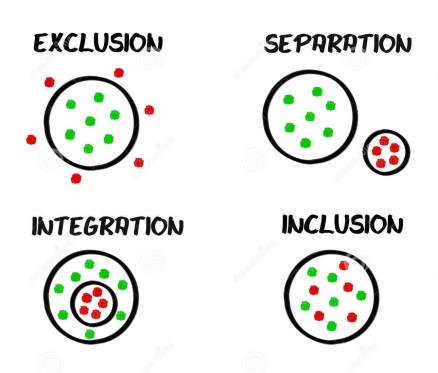
Exclusion – This is common in lot of schools, where normal children and children with special needs sits in different classrooms.
Separation – In this case, the students with special needs sit along with normal children in the same classroom but they are kept aside.
Integration – In this case, children with special needs may be involved with normal children on few selected tasks or activities but does not sit together all the time.
Inclusion – This is the case where the children with special needs and normal children are part of one another. You should not be able to the see the difference between child with autism and without autism in this setup.
Below is a similar picture which she shared in the presentation:
CHARACTERISTICS OF AUTISM IN CLASSROOM
1) Sensory – The difficulty in taking sensory input in ordinary ways as most of the children would. A Sound of a fan or air conditioner could be bothering for few children.
2) Language – Since the disorder has a wider spectrum there will be children with no language or children with good language but no pragmatics in them.
3) Perspectives and Beliefs – Lot of these children may not share your point of view or perspective. So we have to be aware that they lack “Theory of Mind” and they will not be able to say things the way we would.
4) Routine – Routine is very important for these children, so they know what is going to come next.
5) Transitions – They should be aware of what is coming next, so that they are prepared to move from one activity or setting to another.
6) Structure – They should know where they can find the resources they need.
7) Play – These children will not be part of any other play or social situation as you would see with other children growing up.
(Disclaimer – Most often Routine, structure, Transitions are extremely rigid in the minds of adults, we believe that there is a fixed time table for these children and they follow it in order to become successful. The biggest challenge in autism is that they will grow older with functional fixedness in the brain, which is an inability to accept even the slightest of changes.
In her school, there is no structure within the classroom, they don’t have a time table, they don’t have a fixed break for refreshments or snacks or lunch, there is an overall time period when things will happen which is not like how other schools does where bell rings for every period/class. She has found success with such a liberated system within the classroom. The child knows where they will get what resources in the classroom, child knows when they could take a toilet break, child knows how to ask for a break and a child has ways and means in which they prepare for transitions.)
FIRST STEPS – CHILD WITH ASD IN CLASS
1) Connect with Mother – This is a first thing many avoid to do, as the teacher would be overwhelmed with what the parent is going to say. However, parent is the only one who knows enough about the child. Gather information from them and also ask for Reports, Assessments and therapies the child undergoes, which gives you a whole picture about the child and allows you to be better prepared for handling the child.
2) Make a list of child’s strengths – You need to know the strengths of the child to help them interact within the classroom.
3) Understand how they learn – We do a VAKT (Visual – Auditory – Kinesthetic – Tactile) profile, to find the modality of learning that will suit them. Most children with Autism are visual, but you will see combinations like visual with Kinesthetic or other areas, hence it is important to know this information.
4) Ask for additional help – If the new child is going to be very demanding in the initial stages, and the teacher does not have further bandwidth as she is already engaged with other children, in which case you can ask the parent to provide or be a shadow teacher or a school can support the classroom with additional person during the transitional time for the child to settle down.
5) Have a behavior plan in place – For child with autism, it is imperative that you have a behavior plan right from the start. You need to aware of the triggers, existing behaviors.
GUIDANCE TO SUPPORT
1) It is possible for a child with autism to move up the spectrum. Do not conclude/assume that just because a child has a severe disability right now, this is how he/she will be forever. Children are capable enough to improve from their present state.
2) Like all kids, children with autism have strength and weaknesses
3) Be aware of sensory issues faced
4) Get used to the rocking, pacing and flapping, do not view it as a negative. It is the way in which a child can calm down in social situations such as classroom environment. As long as it is not disrupting the child next to them and not disturbing their concentration.
5) Social situations are difficult for all children on the spectrum and classroom is part of such situation.
6) They often experience, difficulty with motor skills. Be little more liberal in motor skills, they cannot write as fast as other children can.
7) They have plenty of ideas or opinions even if they cannot verbalize that. Hence have them involved in activities, you will come to know from their actions what it is they wanted to take forward.
8) You cannot communicate the same way with this child, like you do with an average child in the classroom.
9) Abrupt changes in behavior usually signifies anxiety
10) They need extra time to process language, so ensure that you give them the latency or the time period before you provide them with the next set of instructions.
11) Repetitive activities are calming for child. Do not ask them to stop those actions, that is not going to help the child calm down within the classroom.
12) The golden rule is, if you met one child with autism, you met only one child with autism. Every child on the spectrum is different from each other and you cannot fit all of them in to one category.
13) They have many special interests
CLASSROOM STRATEGIES
1) Happy corner or calm corner – Create a happy corner in the classroom specific to that particular child. This could not work for every child as for few it could result in over stimulation. Create the corner by involving the child in the process and whenever the child needs the break, he will move away from the group and sit in that corner and engage himself like read a book which they love.
2) Watch over the child during free time and recess
3) Give Choices – Give them choices with activities and also give them choices visually and auditory.
4) Create a comfortable classroom – Be aware that your classroom decoration may be overstimulating to a child with autism. Classrooms should have the ability to cutoff light or air so that children feel comfortable from sensory perspective.
TEACHER STRATEGIES
1) Respect the patterns – Make a note of them and use it to your advantage.
2) Prepared to give instructions in multiple ways – Provide an auditory instruction but also be prepared to provide a visual instruction.
3) Provide instruction in as fewer words as possible – Restrict the commands to 5-7 words rather than two long sentences, which confuses them.
4) Don’t take hurtful words personally – Kids may say really nasty words to you, but they don’t mean it. It’s purely due to lack of pragmatics and lack of usage of the language, hence they speak literally. Do not treat it as an offence to you, use that as an opportunity to teach them a better way to communicate the same message.
5) Don’t surprise your autistic students with sudden changes – Prepare them, even in case of emergency prepare them by showing a red flash card, so that they are prepared to receive an instruction that needs to be followed.
6) Don’t be afraid to spend time teaching very specific social rules and skills
7) Use positive reinforcement over punishment – When a child is having a tantrum for which you decide to send him outside the classroom is counter productive. You want the child to learn and control their behavior and teach them what is the appropriate behavior within the classroom.
8) Accommodate the child with time and space to self-regulate
9) Look for alternate ways child with autism are trying to communicate
10) Remain calm during even the worst behavior – When child is in the midst of a tantrum and you are going to raise your voice, scream at them or do whatever it is to stop their behavior, the child will not be able to do it. The child is exhibiting that behavior for a particular reason, so by increasing your behavior, you are only increasing their anxiety and rest assured that behavior is now accelerated to a severe condition from where it was initially.
11) Speak literally and avoid even the most common idioms – Giving them indirect commands or sarcasms does not work.
12) Use photos as examples of what a finished product/completed task looks like – In case of worksheet use an worksheet completed by a typically developed child and show them what is looks like as a finished worksheet and take that away and now ask them to do it. They will then be prepared for what is expected from them.
13) Support transitions – Prepare child for new activities or places – Even moving from a classroom to Physical education room, 5 minutes before give them a heads up like clean the room, we are now going to move to PE room,etc.. Have certain structures, which are typical for transitions like let all the children get in to the line and hold each other friends and start walking. Always pair children with autism with a buddy.
14) Give them breaks – Have a corner in the classroom for breaks, teach the child how to ask for breaks, if the child learns 50% of what is expected in the classroom that is enough, the goal is for the child to learn as best as possible what other typically developing children are doing and not to do the exact same thing that they are doing.
15) If behavior persists, complete an ABC analysis.
16) Key objects these children finds comfortable or reassuring on hand – Lot of children on the spectrum like sensory toys. They like Fidget spinner, or any item, that keeps them calm. As long as these items are not going to cause any harm, there is absolutely no reason why we have to be so stringent that we take it away. Even from the participants especially women, when you go for an interview you will be twirling your hair or playing with your nails or shaking your legs, aren’t we all are autistics in that way. Don’t prejudge the children that they are far worse and these behaviors needs to be controlled. They should be allowed to carry objects that makes them comfortable such as soft toys (Erasers).
17) Help with organizing visual schedules
18) Present your autistic students with clear choices – Don’t speak of the choices in an elaborated manner, wherever possible use your hand or use visuals etc.
EFFECTIVE STRATEGIES TO MANAGE BEHAVIOR
1) Prepare – Each day take the effort to prepare the child as to what’s going to happen.
2) Expectations – Set expectations for what their behavior should be.
(In her school, she has something called as a Central Agreement in the classrooms, which is gone through with the child as soon as the child enters the classroom everyday. Like, we are going to have Calm Hands, we are going to have good words, we are going to have inside voices, we are going to have walking feet, etc.)
3) Compliance – You cannot expect compliance from a child, unless you start rewarding for Compliance. This is where things go wrong. Most adults are happy when the child is sitting, but we forget to reward them or acknowledge them when they are sitting, but the moment when they stand we control that behavior and say please sit down, I don’t like you standing. If you do not reward the positive or the accepted behaviors they won’t know what is acceptable, it will keep going back to the negative behavior to get your attention.
4) Privileges – Let them earn privileges within the classroom, even for accomplishing simplest of things. Like when they help out, when they are sharing, etc..
5) Choices – Choices can increase compliance, as they are taking the initiative.
6) Visuals – 90% of the children on the spectrum relate very well to Visuals.
7) Schedules – They are not stringent timetables, it is simply a sequence of activities that the child needs to go through.
8) Transitional object – any object that makes them comfortable to shift from activity A to activity B. For example, if you are moving a child from the activity of playing building blocks to writing worksheets, it is ok, if the child carries one of the blocks with him/her while doing worksheets, they will return the building block once they are ready. Please don’t be authoritative like only when he lets go of the building block, he can proceed with the worksheets, in which case the child is not going to be interested or motivated in the activity to be performed.
9) Redirect – Instead of trying to control the behavior, redirect the behavior. Give them a break, provide them the choice to go outside the classroom, etc. by redirecting the behavior, you are avoiding the behavior getting escalated.
10) Sensory Overload (When a child is overstimulated by sensory input, provide them a quietest place to destress) – The activity done inside the classroom may itself be causing a sensory overload for the child. When children are excited, they would be talking and screaming, you cannot control those things which could be a sensory overload for the child. When such instances are happening, redirect all the children saying that we are getting little louder, which will upset that child, so can we lower our voices which will help him. The redirection should not be to the child on the spectrum, it is for the rest of the children in the classroom, so that they can be mindful of what is happening.
11) Instructions – It should be clear, short and precise. Give latency and repeat it for second time.
12) Child’s lead – Take child’s lead for success.
13) Clear end – Have a clear end to the activity, as they do not know how long an activity is going to be done. Like an alarm or timer.
14) Structure
15) Be responsive (Stay calm when interacting with the child) – Accept and acknowledge a child when they are calm, then you will have higher incidence of child continuing being calm and continuing that behavior because you have established what is expected out of them.
WHEN A BEHAVIOR BECOMES CHALLENGING
Below is the sequence or order in which a normal behavior gets escalated in to a challenging behavior:
Refuse or Ignore Request > Behaves in socially inappropriate ways > Aggression or Tantrum > Hurt themselves or other children (head banging, biting, pushing etc.)
WHY DO THEY BEHAVE IN CHALLENGING WAYS
1) Have trouble understanding what is happening around them (When all the children are screaming or talking with one another, the child cannot understand what is being spoken)
2) Don’t have effective ways of communication (Hence they resort to actions, which are nothing but behaviors to show their frustration)
3) Are very anxious and then emotional brain takes low road (This is a flight or fright response, instead of going through the cognitive processes of processing, logical thinking, planning and organizing)
IDENTIFY TRIGGERS
- Routine and Rituals
- Transitions
- Sensory Sensitiveness
- Sensory Overload
- Unrealistic expectations
- Tiredness
- Discomfort
- Other conditions (co morbid conditions like epilepsy, ADHD, etc)
MANAGING CHALLENGING BEHAVIORS
There is only one known way of how we take it forward to get a solution. That is to replace the challenging behavior with more appropriate behavior using the ABC Triad. Where A stands for Antecedents (Triggers), B stands for actual behavior you can describe in measurable terms (Like not child was crying, instead say how long the child was crying, the intensity of the crying) and C stands for Consequence that is immediately what the child gets i.e. SEAT, they get a Sensory feedback, Escape an activity, they get Attention or it is a Tangible (They want something)
To develop a behavior support plan we should
- Track the behavior
- Identify Trigger / Reasons
- Create behavior support plan that works for the child
- Implement and Track Changes
- Review Plan and Re-Adjust, if you continue to see an escalation in the behavior
To have a proper behavior support plan in place, you need to have a experienced ABA practitioner or board certified analyst and it cannot be something that you decide to do on your own knowledge. You will not be able to see the minor triggers that are actually there for the child.
THERAPY TO IMPROVE BEHAVIORS
- DTT – Discrete trial training – It works on the operant conditioning of the child.
- Incidental training – It uses natural opportunities to teach children what is expected out of them.
- PRT – Pivotal response training
- PBB – Positive behavior support
- PECS – Picture exchange communication system
Q & A
What is the difference in classroom strategies in Urban and Rural setup?
The difference is from the strength of the children and not from the area perspective. In fact, she things in a rural setup she could manage all of these in a much better manner than in urban setups. You can have up to 16-20 children in a classroom, of which 3-4 can be with Autism of other developmental disabilities, its more about maintaining this ratio, so that a child has typically developing child on his two sides who can support them and help them and they learn through model behavior.
Is it possible to get a BCBA in Chennai?
In Chennai, we are fortunate enough that we have 4 certified professionals available. As first step, teachers should be able to identify a behavior issue in the classroom and secondly, how to work with Board certified person with the support plan provided by them.
How do you sensitize the normally developed children when you have mixed ability children in the classroom?
I never needed to sensitize the children, I only needed to sensitize the parents. The children are extremely empathetic right from day one, they take responsibility, they care for the children, they don’t let the children down. It is as an adult, when you show difference in treating them, children pick it up from you, they do not have the skill as is. In our school we desensitize the parents by allowing them to observe our classroom with children with autism during admission inquiry, in most of the times, they would not be able to identify a child whether he has autism or not. The rule followed in the classroom is same for all children. There is nothing wrong for a typically developed child wanting to spend time in happy corner meant for autistic kids, as long as the child finishes the task, he can do anything, which is her philosophy.
The problem is that, the education is taking away the love for learning from the children. People wanted it to be table and chair system and does not want to break away from that.
Children from Montessori schools often present themselves with lack of social interaction, it’s a material based learning which they are accustomed to, also the classroom is mixed of different age groups there, when they move to a typical classroom model, how do we convince the teachers?
Teachers needs to be empowered as well. I am associated with the school I started for my passion and I am also associated with the Therapeutic setup. From my Therapeutic setup I work with 3 montessori schools, and several other leading schools as well including Chettinadu vidyashram, Sishya, Tips in trying to integrate these children and plans to make them successful. I think the change comes from the management, it cannot come from the teachers. If the school management believes in inclusion, they will automatically mandate every teacher to be more sensitive to the child and make them go through necessary workshops that will prepare them to handle children with special needs.
She has been speaking in favor in including children with 13 more neurodevelopmental conditions which are ignored at present, so that they get the required recognition as well.
For example, we have a 4 year old child who pushes his peers, how do we stop that?
It is important to have an ABC in place. He is not pushing the child as he wants to push, he is pushing for attention, another turn of the activity etc. If we understand the reason, then we can put some plan in place to overcome it.
The child is pushing other children because he does not like the shadow teacher ?
One of the issues in having a shadow is that, if the child becomes over dependent on that system it is going to be counter productive, and the shadows are not trained which is another issue faced as well. In our school, we follow a rule that we do not want a shadow teacher in our classrooms, unless it is absolutely necessary. Even if we hire shadows, what happens is that shadow may either pinch the child, or push the child, or mildly hit the child, all of these things are sensorial disturbances for child and the child is going to be away from the shadow. He may not have the words to tell you that he wants to be away from the shadow, but by pushing the child he can get exclusion or avoidance of being with the person, so he would show that behavior.
What is the age in which you take admission of children with special children in your school and what is the process?
18 months is the minimum age criteria. Our school has 32 children, our ratio is 4 to 6 in admitting children with special needs. We have 2 teachers for every 20 children, in preschool it is 1:6 and in Kindergarten it is 1:8. Every child who comes with developmental disability has something called as IEP (Individualized education program), within our school. The IEP dictates the level of the child and what we can do. We have also chosen curriculum’s that are supportive to our children, like up to kindergarten we are reggio inspired preschool model, its emergent learning where the learning comes from the environment and we go for IB PYP ( International Baccalaureate® Primary Years Programme) program, where it is not focused on text books, it is focused on instruction and unit of inquiry on hand.
How the teachers are selected in her school, as the children are differential in nature?
We have a 3 step program, 1st is the induction program where they have to undergo a two week training program. There is a mandatory professional development program every month, and they have a closure program as well. Whatever we do as professional practice in that month, needs to be seen in the classroom and monitored by each other. Not only for autistic children we have reinforcers, we have reinforcers for our teachers as well. We have broken them as token economy system. We actually given them a day off, if they caught certain number of stars etc. She is not explaining the grassroots model as such, as it may not be possible for every other school to adopt it.
Does your school have extra curricular activities as well?
We have sports, Music, Dance, Drama and Theater for these children.
My Personal feedback:
Her presentation is very crisp and to the point, she articulated what she wanted to the participants clearly. She was very time conscious as well on completing the presentation within the allotted time, which was not complied by other delegates during the conference.
She is qualified academically, done her research, gained experience and moreover her passion made her to venture in beginning a School, which you do not see from many specialists in this field. It is good to know that such a school with Inclusive model exists in Chennai, hope they succeed with their efforts and expand their base to benefit many other children with developmental disabilities.
Regards,
Saranya and Karthikeyan
karthiksaranyaparents@gmail.com
 Autism Spectrum Disorder - Personal Experiences (Chennai Family)