Hi All,
sharing the details of a very old presentation i attended last year, lost many such drafts when my laptop crashed, was able to recover few of them. It is not complete, but the information that was shared in the session was very knowledgeable and gives an understanding of your child from a different perception. Hence sharing the post with whatever information i was able to gather.
Topic – Enhancing Communication in Children with Autism
Date – 23rd August 2020 2 pm to 4 pm IST
Mode of Presentation – Online Webinar
Speaker – Ms. Deepa Bhat Nair – Speech and Languge Pathologist
Master Trainer, DBN Com DEALL Mumbai. Experience of 25 years
website – http://www.communicationdeallmumbai.com
Below are the points shared in the presentation:
- As a speech therapist one of the most common question which is asked by every parent is “When will my child speak ?“. The answer to that is not simple, it is very complex, because the function or the Process of speech by itself is very complex. She shared the below image titled “The Speech Chain”, which is available in google. She breaks down the picture and explains in detail, this is the part which i want every parent to carefully follow:
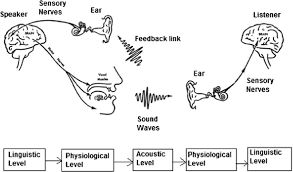
- Basic speaking involves at least two people i.e. a speaker and a listener
- What we speak is determined by our brain. The different parts of the brain must come together.
- There is a dictionary in our brain, from which we would pick out the words for speaking arranged in form of sentences with proper grammar.
- After that brain moves on to generate the sounds that will produce the words which you wanted to speak. These commands travel through nerves which connect our brain to the mouth.
- When producing the sounds for the words decided by the brain, different parts of the mouth has to work in coordination i.e. our lips, tongue, palate, Vocal folds needs to move. Every aspect of the mouth has to move in synchronization to produce the sound.
- From the side of the listener, the sound waves generated by the speaker reaches his ear, through the nerve pathway it reaches the brain. The listener has to access his dictionary in the brain, to understand what the speaker has spoke.
- When we speak, we also hear our own voice in parallel, where a feedback loop happens, which tells the speaker whether he is loud enough or audible enough.
So each of the above parameters needs to work efficiently for a child to speak properly. We as a parent, needs to observe and see in which area our child is lacking so that we can help the child to overcome the challenge. Seek professional help when we cannot figure out by ourselves.
- Below are few of the Communication Challenges that are commonly faced in Autism:
- Non verbal
- Literal in their understanding of language
- Difficulty with understanding language
- Not enough speech – single words, phrases, poor narration
- Echolalic speech
- Difficulty with pragmatics – interrupt abrupt, blunt, not polite in the way they talk, not appreciating humor, getting bullied/bullying, no friends, easily hurt.
- Monotone, too loud, too soft, fluctuating pitch and / loudness, nasal
- poor clarity
The ability of speech is dependent on the various parameters which we have discussed above, based on which some child may not be able to speak, some child may take everything in literal
meaning, some cannot understand sarcasm, some speak in single words, some may speak in phrases but will not be able to narrate, some will have echolalic speech, some will have difficulty with the use of language. They may interrupt you, they may not be polite in talking, they have difficulty in understanding jokes, etc..
- Some children are too loud or too soft. There can be two reasons why a child is too soft, we will have to look at the speech oral motor system like what is the pressure of the breath that is coming from the lungs for the child to be able to speak. How the child is using the different parts of the mouth in order to modulate or change the air that is coming out from lungs. If there is a problem in the oral motor system, the child will have difficulty in speaking loudly. Some times the oral motor system may be ok, but the child may have difficulty in the feedback loop, the child may not be able to hear himself very well, in which case we will provide visual supports to show what is meant by loud and soft, and help the child to understand the difference between them.
- Clarity of speech will depend upon the oral motor system. If oral motor system is not working well then oral motor therapy will be required. Some times the oral motor system is working well but the selection of sounds in the brain is not happening properly. In some cases child may be having an immature form of speech. When the child is beginning to speak, one should not correct the speech of the child, we should give enough opportunity for the language to develop, so that the clarity improves.
- Build the Skills
- Foundation – Pre-requisite Learning and Toileting Skills
- Understanding Capabilities
- Motor Skills (Gross and Self Help) and Receptive Skills
- Expressive and Social Skills
- In Comdeall therapy environment, expressive speaking is the last aspect which will be worked upon, the first and foremost area to be worked upon is the Pre-requisite Learning Skills (PLS) and Toileting Skills. We will also work in parallel in making the child understand the language and the motor skills. In Autism it is a team approach, one therapist cannot solve the problem by himself. You need SLP, OT and Spl Ed.
- This is the video which she shared explaining the different aspects of Pre-learning skills. Majority of the session was done by going over different parts of this video. Video is a must watch https://www.youtube.com/watch?v=hNxVxw34RP8.
- If you work on your child, on speech directly without completing all the Pre-learning skills, he would have a patchy development. Examples are, child will not initiate speaking, Child has some words but not using it all the time, child does not know how to begin a talk, child is not socializing, etc. These problems will get addressed when we focus on the PLS.
- In the COMDEAL program, when the child is very young we work intensively on the Pre-learning skills for 3 months. If the child is older than 3 years, it will take longer say from 6 months to well over a year to build these foundation skills, before we move to Expressive language development.
- The Pre Learning Skills which needs to be focused are:
1) Sitting Tolerance
2) Eye Contact: Familiar / Unfamiliar people / Surroundings, individual/group, brief / sustained :
If you do not have the sustained eye contact, you will not know who is the person talking to you and you don’t know whom to look at. Our mental vocabulary, will not develop as expected.The important point is that your ABCs, 1234s are skills that require direct teaching, whereas in case of language, children are born with the inbuilt ability to pick up language on their own. As parents if you want to develop the language of your child, ensure Pre language skills exists so that child has the ability to pick up language by himself, and provide a rich language stimulating environment for the child to learn from your interaction. Response to name calling.
3) Gaze shifts, maintaining across a distance
As a baby they would only move the head to track an object, the development of moving the eyes alone comes at a later stage. You can see this symptom is lot of our children as well where they would move an entire head to track a moving object instead of moving their eyes alone. We need to focus on motor skills here as well.
Gaze shifts allows the child to learn about moving objects. By looking at a ball which the child has rolled over, he will learn that due to his push the ball has moved and the pressure of his push has made the ball move to such a distance.
4) Joint attention – It is where two people are looking at the same object simultaneously. Unless the child interacts with another person, there will not be an intent / desire to
communicate. The highest form of joint attention is where the kid sees something and points his fingers there and looks at the parents eyes whether they are seeing the same thing which
the child has seen. Joint attention is the Pre-requisite for the child to initiate communication. Many parents often say that my child will not even realize that whether as a parent we are around him or not. This is due to the absence of joint attention.
5) Attention – when attention is not in place your social skills and communication skills will be impacted. As babies the child will spent very little time with the toys say few seconds, later by 1-2 years the time spent on the toys will be more, it is called an Exploration stage. Also by age of 3 years a child should able to sustain attention in a single activity
for 10-12 mins. One must know that even when babies are not talking, the parents should talk to them naturally. It is incorrect to think that just because my child has not began speak, i will
not speak with him. Also some therapists suggest that if the child speaks in single words, parents should also speak in single words, there could not be anything more wrong than that.
6) Pointing, gestures – There are lot of actions and expressions a child does, even though he has not began talking. For example, pushing away the spoon to communicate that he does not want food, provide gesture that he wants more etc. When we talk about autism, when we insist only on speech we deny the ability to communicate in totality. We should not deny the capability of a child to communicate himself through actions or expressions or gestures. It is important that early on, one should think of total communication, that is we help them to communicate either through pictures or through gestures as quickly as possible, so that the child is not frustrated. None of us can learn if we are frustrated, anxious, nervous about speech, to being these down, we should introduce all forms of communication as early as possible. We should provide this ability to our children as early as possible.
When the baby says aaaa baaa (humming), it is called as Vocal play, the baby is experimenting with the vocal system. These experimentation helps the brain to slowly modify, and move towards speech.When a child sings during therapy, that needs to be encouraged, when they play around the vocal system, they will move to the speech.
Pointing to communicate is a very important communication skill which children with autism lacks, we need to work with therapists to bring that in. The earlier the child develops the pointing habit, better it is for the child’s development.
For example, a child in early stages would like to have a biscuit which the mom was holding in her hand, without using any words, just by focusing on the biscuit for a longer time, child communicates that he wants that biscuit. Even before the motor capabilities are developed, the thinking is developed.
7) Compliance –
Many times parents says that their child knows everything but he does it only when he wants to, and doesn’t do it when we ask the child to do it. Being able to take instructions and follow them is known as compliance. Many times compliance issues happen because the child has a genuine difficulty in understanding the command or instruction you have given to him/her. For example, you ask the child “come here”, the child may understand the command, but he is unable to move his body towards you. This is where prompting and helping the child to move becomes useful. The more you understand about the child’s profile, you will be able to classify whether the child is stubborn or has a genuine difficulty in following the instructions given. As a therapist i would say, please give the child the benefit of the doubt. Putting pressure on a child, who is unable to follow a command will create frustration, behavioral problems, crying loudly, effectiveness of therapy sessions will decline.
8) Imitation
- General Guidelines when working on PLS :
a) Sitting Tolerance:
i) When you initially work with sitting tolerance, ensure that the child is sitting in the corner side of the room and you sit in front of the child, so that you do not provide too much space for the child to move around or run around.
ii) You start with activities that is of high interest to the child.
iii) Slowly move on from high interest to low interest activities.
iv) Visual cues are important for the child, so either use table and chair for the child to be seated in it. Else if sitting on floor, use a mat,towel or mark a square in which child is expected to be seated during the activity. This will provide the clarity and understanding to the child, where he should be seated.
v) Go along with the child interests or Follow the childs lead. Do not say, like dont do it, not like that, do it this way etc..
vi) For a child who does not sit well, you should try to box him in to a corner so that the child is restricted to a very limited area of movement.
vii) Initially do not force the child to sit, play with the child as much as possible so that the child enjoys the company of the therapist in first place.
viii) Be gentle with transitions, do not abruptly change or grab the object from the childs hand. You slowly involve the child is the new activity which will divert away the focus of the child from the older activity gradually. You always replace one high interest activity with another high interest activity for the child.
b) Eye Contact
i) For eye contact you should use brightly colored objects or items that makes lot of sound.
ii) The positon in which you hold the object is very important, keep it closer to your eye level
iii) Masks, Bindis, moving objects are few examples that can be used for Eye contact.
iv) Keep moving the objects back and forth, use variety of objects with different colors will help the child to sustain the eye contact for longer time.
v) Sustaining eye contact is important skill for classroom, where the child has to copy write by looking at the blackboard or listen / learn by looking at the teacher or board etc.
vi) Use visual cards as much as possible.
c) Gesture
i) Use a flash card and also speak the word to the child, so that you reinforce the word and the picture means the same thing, which increases that understanding.
ii) Holding the child hand, and making the child to show a gesture will really help.
- Building blocks for socialization are built even when the child is less than a year old. If you do not work on social skills initially, thinking it can be taught at a later stage, it will never happen. Social skills tranining needs to happen from day 1 of the early intervention to the child.
- WE CAN TALK – A Place to begin
W – Wait, watch and wonder about what the child is communicating.
E – Examine your position. Exaggerate and entice with your voice and gestures to increase imitation
C – Comment on what you and the child are doing, seeing and enjoying
A – Add singing throughout the day
N – Notice when the child initiates communication, be alert, respond to it and build
T – Take turns talking. Give the child time to respond
A – Ask questions to reduce frustrations but use the sparingly
L – Laugh a lot. Laughter is a great way to get talking started. Think only how you can have fun with your child, learning will happen automatically.
K – Keep books handy. Reading is a great language builder.
- Hierarchy of skill achievement at DEALL
a) PLS & Toileting, sensory integration and Feeding
b) Motor Skills (Gross Motor, Fine Motor, Self Help)
c) Receptive Language
d) Expressive Language and Social Skills
- Modifying PLS building activities for language development
a) We already know the importance of different PLS in language development.
b) Here we look at how you can modify the PLS building activities to promote language development.
c) One should remember – It is specific to the child’s level of RL, EL and Stability of PLS
d) Address language skills through PLS activities
e) To look at object of interest, name the object ( Eye contact and eye gaze)
f) Helps in building vocabulary ( Joint attention)
g) Sustained attention: Rhymes, Book Reading, Writing
- Use activities that involve PLS to help language building
a) Give appropriate language input
b) Words, simple phrases Eg: During SA activities like: Transferring grains – use words like open, pour, close, up and
down. and when playing dough – use words like roll, press and cut. These are are different action words which the child will learn while playing the activities.
c) PLS activity purely – When PLS is not settled in the child, you use less words and focus on other aspects. Rolling play dough, pressing it, making a shape without much of language input.. Here you focus on joining and sustained attention, may be sitting tolerance
also.
d) PLS with Language – When PLS is settled in a child you use more expressive words such as Play Dough – PLS: Playdough is sticky…, it is sticking to my hand .., we use more language …
- During Rhymes time
a) Call out action phrases for what kid to follow along with: Sit down, Stop, Kneel, walk, Jump and so forth.
b) Sing motion tunes together with your child – Where is thumbkin.. ring round the rosie. etc..
c) Integrate rhymes with vocabulary
d) Teddy Bear, Teddy Bear turnaround and touch the ground rhymes can be used for teaching words.
e) This is a way i brush my teeth, where is thumbkin etc…for increasing vocabulary and learning language.
- Games
a) Play hide and seek with items. Let the child help you hide the item after that inquire. “Where is _? and also have him find it.
b) Make scrap booking projects of various types of items – Food, animals, action phrases, and so forth, cutting photos from magazines.
c) Pages may be designed for adjectives – cold, hot, pretty and so on. Older kids can help with cutting and sticking
- During Cooking
Some great tips and ideas to get into the habit when cooking are:
a) Model Words – Talk about what they are doing. For example, stirring, mummy, cutting, mummy backing, mummy rolling etc., sorting out, separating vegetables,
b) Get your child to have a turn – Turn taking is such a crucial aspect of language. You can take it in turns of stirring. Your child does not need to have a long turn, a short turn will teach
them the aspects of turn taking.
Other general points:
- It is important for the parents to know that they are not the reason for the child’s inability to speak. The entire speech chain has various components which needs to be developed or trained to produce the speech.
- Even if our children are non verbal, we need to ask ourselves that if our child has the basic or functional communication skills are in place, so that the day to day activities can be carried on without putting any anxiety, pressure on the child.
- Even if our children has not yet began talking, we should not change our way of talking with the child. Child needs to hear our regular complex sentences on a daily basis so they learn from them.
- Even if your child is 5 years old, it is important that you continue to provide the stimulus to the child. Make sure the child is felt appreciated when he is trying it out.
- During initial stages of therapy, lot of sensory play is required like playing with rava, daal, rice, channa, sabudana, etc…
- Also when you are training your child, do not say look at me constantly, don’t pull the child’s face forcefully to look at you. You should hold the material, object or flash card at your eye sight level, so that child looks at you.
- When you are working with the child, there are many times you would see the child may not like an activity or object used, but due to communication issues he/she may not expressly convey this to the parent or the therapist. This is where parallel talk helps. When you offer an item or toy to the child and he does not take it, as a therapist you should talk on behalf of the child in that situation, this way child will know what needs to be said during that particular situation.
- Also whenever a child is experiencing a feeling or a emotion, try to speak to the child at that time telling him the name of the feeling or emotion like you are happy , sad, frustrated, tired etc..
- To increase the vocabulary of the child, the child needs to hear the words as and when he experiences it, which is important. When he is brushing, we say you are brushing, etc…
- As a mother if you sit next to the child or side by side or bending around them to work on eye contact , is not a good idea.
- Reinforce positive behavior by praising it, this will increase the likelihood of that behavior occurring again.
- Use Rhymes, speak gently, slowly.
- As a parent, use your voice, modulate your voice, exaggerate an emotion wherever possible, use gesture, increase imitation, increase attention …etc..
- The interventions work well, when the parents continue to work with the child at home as well. So many parents raises the question that he is doing things in the therapy center with the therapist, but he is not doing the same at home. The reason we found in most cases is the frequency at which parents try this at home makes a difference. The parents have to do multiple rounds of repetitions on each day to make things fun for the child, else it will not sink in to the child. Your child is struggling initially, which is the time you need to focus more and do extra and not to have a relaxed approach at this crucial time. Hard work is important, but even more important is putting that hard work in the right way.
- Do not try to teach so many things at the same time to the child, focus on one aspect and concentrate on that during a session.
- Break the task or activities down according to the child’s capability.
- Eye contact, Sustaining Eye Contact, Stable PLS makes language learning more natural. There is no way we can teach each and everything to the child, your role as a parent/therapist is to give the skills the child needs to pick up the language from the environment.
- Language learning and PLS are highly interdependent. Language learning is affected based on the manner in which PLS stabilizes or fluctuates over time
Comdeall has resources that are sold at the below portal :
https://communicaids.com/product-category/teaching-aids/autism-manuals/
Q & A Session
Q – How to stop the mobile screen time for the children when parents want to transition them to a different activity ?
A – If the child is on a visual schedule, you can design the schedule to have a mobile phone time along with the time duration it can be used. Also try to put something which the child really likes as a next activity, water works really well, foam water, anything the child likes very much which can distract the child.
Some times if the child is too much addicted to it, keep the device away and let the child cry for it and make the child understand that time for the device is over , now you need to move on. You need to be firm if the child is addicted to it, it will be couple of days for the child to start listening to you and stop crying but be firm.
Q – How to increase the audibility of the child i.e. child is speaking but the sound level is way low, which is not audible at ease ?
A – We need to review the speech system of the child, especially blowing, sucking skills needs to be checked, which will tell his breath controls. If the child has low muscle tone, we need to work on that first. Practice soft and loud concepts to the child. The issue could also be with the feedback loop as discussed earlier.
Q – When a child is anxious, he is unable to express his feelings, which gives raise to unappropriate language. How to fix that ?
A – when a child becomes anxious, there is a breakdown in the nervous system which impacts the speech cycle. At this point of time, the child should have access to alternate means of communications like gestures, pictures, actions, expressions, communication books, etc…
Q – 6 years old child has good receptive language but his expressive language skills are poor ?
A – We need to check the oral motor involvement, train the child with parallel talk, focus on visual communcation, which varies based on the childs requirement.
Q – Why do some children with autism, split the words and speak ?
A – It could mean the child may need more oral motor exercises. We need to show the child how to combine the sounds together. Many children are able to read before they speak. we could use puzzles, word buildings games and teach the child to construct the word.
Q – Child has ample amount of Vocabulary but does not have the ability to frame sentences ?
A – Pretend play, combining gesture and word will help the child to move from single word to sentences.
Q – How to improve eye contacts with Autism?
A – Hold the attractive objects at face level, use colored toys, glittering glasses, bindi, paint objects on forehead also help.
Q – Child pushes his tongue out while speaking as a result his speech is not clear, apart from family members other cannot understand him ?
A – Exercises like sucking will help the tongue to go inside. We need to figure out whether it is a medical issue with the oral motor system or it is an learned habbit, by doing an assessment.
Q – Any specific diet to improve speech and clarity
A – There is no reasearch or evidence that shows diet can improve or develop speech.
Q – Will there be an impact on childs language development, if two languages are used at home ?
A – Research shows that children with autism are capable of picking up multiple languages. It is a wrong idea to speak only in one language.
Q – For an adult who has not fully developed PLS, can we still go ahead and teach him ?
A – For adults we focus on functional language, an adult may not be interested in communicating in a fashion provided by PLS. Look for cards, books, apps to communicate.
Q – Is is true that 7 years of age is the maximum that a child can acquire speech ?
A – No it is not true at all. I knew people who has began speaking at a much later age. Also look for alternate modes of communication as well, if the child has not spoken till 7 years of age, to avoid frustrations.
Q – For a child who is of 1.5 years age, there is a speech problem should we start therapy now or wait for some more time?
A – Start as early as possible. Research shows that the earlier you start better will be the results. When the children are young they respond well .
Regards,
Saranya and Karthik
karthiksaranyaparents@gmail.com
 Autism Spectrum Disorder - Personal Experiences (Chennai Family)