Hi All,
The below post is related to a topic which was part of the Conference / Workshop organized by Vasantham. Below are the details of the session:
Conference – Workshop cum conference on Best Practices in the rehabilitation of individuals with special needs
Topic – Concrete Pictorial Abstract approach in Math
Date – 17th March 2023 01:30 PM
Mode of Presentation – Offline Venue – Sengai Meenakshi Mahal, Mogappair, Chennai – 37
Speaker – N.Malathy – Special Educator from Sankalp , The Learning Center and Special needs school. She is also a mother of a child with special needs.
Below are the points shared in the presentation:
She has struggled when it came to making her child understand the concepts, which is when she went seeking professional guidance.
Initially she went to Ramachandra with her child, as parents were allowed to sit along with the child during the therapy/teaching sessions. She observed the approaches followed in teaching the child and how the child was responding to the same.
Her child has something called Rote Memory, where the child remembers stuff through repetition and not by understanding. He was learning through pictures, but he was not understanding them. He can find a picture of an apple, he can bring a picture of an apple to you, but he does not know what an Apple is.
This is when she came across the principles founded by Jerome Bruner i.e. the three stages of representation, which made learning easier. Bruner theory is that you first begin teaching your child with Concrete Representation, after that you follow Pictorial Representation and finally you teach them through Symbolic Representation.
For example, when you teach about a bird i.e. Crow, the first step is to show the bird in real life, after that you show the bird through pictures and finally you draw something that looks like a crow through which the child will now be able to identify that bird. This is how language development happens in the child. All languages will move from Concrete to Abstract.
In short the approach is referred to as C P A i.e. C is for Concrete, P is for Picture / Pictorial and A is for Abstract.
Concrete stages refers to Enactive Stage where the child learns through real life, touch and feel sensation. This is an ego centric way of learning, where child things everything that is happening around him is only due to his presence/actions.
Pictorial stage refers to Iconic Stage where the child now understand what is there in the picture is an actual representation of the physical object they have already experienced. In other words, this is an internal representation of external objects presented visually in the form of a mental image or icon.
Abstract stage refers to Symbolic stage where the child was now understand the same through a symbol which may or may not have a direct relation to the Image or real life object. At this stage, the information is stored well in the memory.
In concrete way of learning,
- the child is doing things, there is an action that happens throughout
- He experiences the learning through sensation instead of perception.
- You get the attention of the child
- You bring the concept in to a life form
In school environment, she uses marbles as manipulatives. (Be careful when using tiny objects as children will put it in their mouth often.)
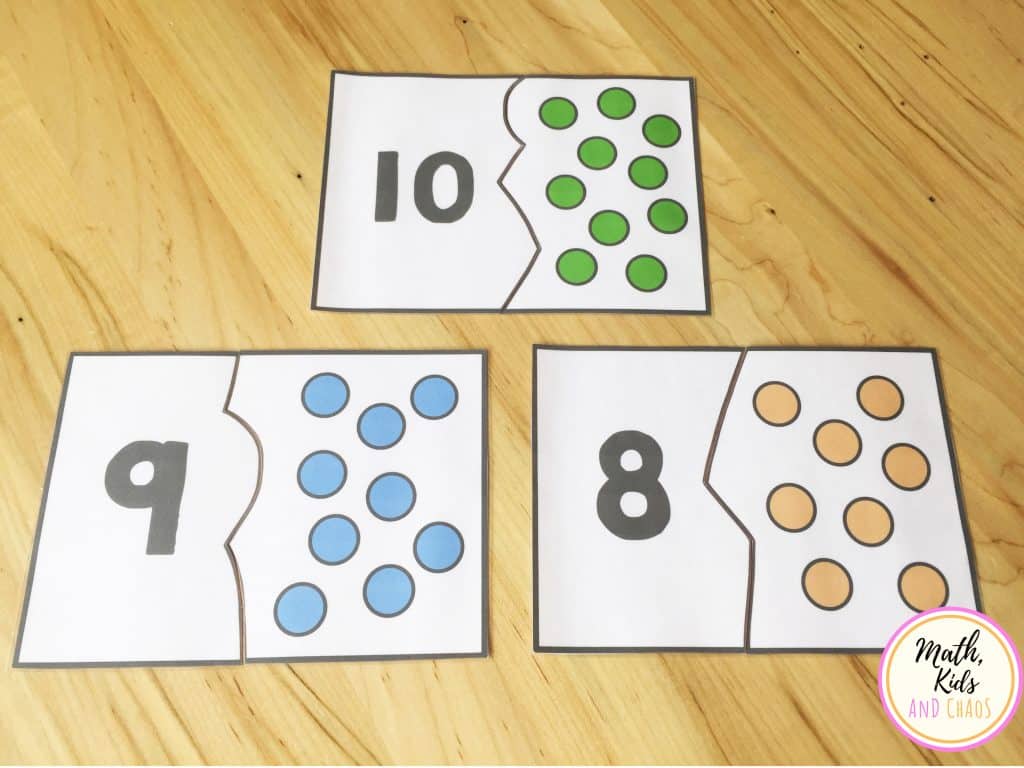
She spoke about a TLM (Teaching and Learning Material) which she prepared for teaching numbers, where each number will have a dot representing that count. i.e. 1 will have 1 dots, 2 will have 2 dots etc. The child will be given the marble, where he will count the marbles and place the manipulatives on the numbers. After the physical experience, we teach the number symbol to him so that he can relate the number symbol to the number of marbles which he used for that number.
Below are the random google images which are identical to what she has displayed:

If we are teaching addition to the child, first we have to use objects which the child can touch and feel, as Physical objects are a lot easier to use as Manipulatives for learning a concept.
Some parents address their concerns here that their child will not look in to the objects, he has tactile issues or he is more of a visual or auditory learner. But in reality all children will love to use a manipulative if they are colorful or attractive for that particular child, it is the duty of the parent to decide on the suitable manipulative for the child.
The child will be excited to try it out, not because he is understanding the concept, but purely because he is handling manipulatives that are attractive for him.
For example, when teaching number 1 which is a symbol we should first teach an object that represents the count 1, allow the child to play / explore with it, after which establish a link between that 1 count to 1 numerical value which is a symbol.
When the child does (actions) something they will learn, when they listen they forget most of the things which they have listened.
She showed many activities using different manipulatives like building blocks etc.
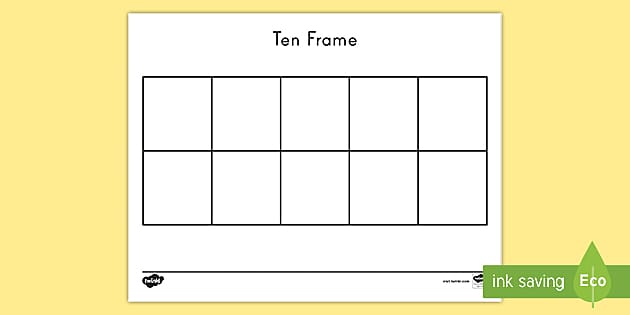
She showed the concept of “10 Frames” that is widely used in the teaching world. It is used for teaching various math concepts to younger children. She illustrated with an example of how it can be used. It is widely used for teaching counting, place values, additions, subtractions, fractions, divisions, skip counting etc.
Below is a random google image of what Ten frame looks like:
We invest more time on the concrete stage, which shall provide a strong foundation in all concepts that we are going to build over it.
Even for teaching concepts like long – short, big – small you first use objects to teach the child, then you generalize using different objects and finally you arrive at pictorial representation. What they saw in the concreate form, they will be able to associate it towards the picture they see later.
There are many ways fractions can be taught, but one easiest way to teach is by using a Play dough or clay. You roll the clay on to the floor like a rope form and then you cut it, this becomes half. By providing a concrete material like clay or play doh, the child gets to feel the texture of the material which provides a tactile experience, this will be his reinforcement or reward during the learning process. Kids learn new concepts in a quicker speed than you imagine. (Wonder why we have never been taught like this during our learning days.)
When is the right time to move from concrete to pictorial stage or when to wean off the concreate stage of learning. There is no hard and fast rule on this, it is purely depends on the child’s understanding level. There will be instances where child would already be on the abstract level, but some concepts they may not be clear so you can always go back to concrete model of teaching and come back to abstract. But the suggested time to wean off concrete is when the child becomes comfortable in learning through pictorial representation.
When you are teaching a concept using an TLM or object, kindly use different objects frequently to provide variation and generalization. Same way, if a child does addition well in 10 blocks, make him to do addition in building blocks the next day and so on… When the child is able to provide a consistent output through different learning materials, it means that he has achieved generalization and understood the concept, it is time to move beyond or further. They will be at the level where they wont even need an abstract representation, they can do the math mentally just like the older generation people do.
From her personal experience she feels that this way of learning works well with all types of children i.e. Neurotypical and Neurodiverse, irrespective of the learning style (visual or auditory or tactile)
This method can be used not only for teaching math concepts, they can be used for teaching all other subjects as well.
My Personal Feedback:
It is always a pleasure to learn about structured and proven way for teaching kids, that too by a special parent. There is a personal connection which a parent exhibits as they are not motivated by the financial rewards, it goes beyond that. So their depth of understanding a concept is more sincere than a student who may pursue it as a mere profession.
The model outlined by the CPA is how things were done many years back. But every since schooling became a trend for kids less than 5 years old, everything that was in a construct form turned out to be a pictorial form, where children are exposed to pictures first, which is where we are going wrong. Schools should come out of the traditional mindset where academic material should only be books and nothing else, they should provide safer, easier to use TLMs as part of the study material to kids of younger age to encourage curiosity and exploration. This is going to only make life easier for teachers of upcoming grades/levels.
I liked her presentation very much, she was so crisp to the point, backed it up with examples and personal experience. Parents of younger generation should learn more about this teaching concept which will make their life easier when teaching kids who are struggling.
Regards,
Saranya and Karthikeyan
 Autism Spectrum Disorder - Personal Experiences (Chennai Family)