Hi All,
The below post is related to a topic which was part of the Conference / Workshop organized by Vasantham. Below are the details of the session:
Conference – Workshop cum conference on Best Practices in the rehabilitation of individuals with special needs
Topic – Skill Training – Vocational
Date – 18th March 2023 1:30 PM
Mode of Presentation – Offline Venue – Sengai Meenakshi Mahal, Mogappair, Chennai – 37
Speaker – L.V.Jayashree – Applied Psychologist and Special Educator, Director – The spastics society of Tamil Nadu , Chennai (Taramani)
Below are the points shared in the presentation:
She clearly mentioned that she is not here to speak as an expert as it is the parents who are the experts, she is here only to share her experiences,
Everyone is aware of IEP (Individualized Education Plan) which happens in academics, however after IEP the next step is to have an ITP (Individualized Transition Plan). The objective of ITP is to create goals/plan that will help the child to transition to post school life.
Vocational Placement is like a jigsaw puzzle, each puzzle piece comes with a peculiar shape. Likewise each of our children are very different and unique. One size fits all approach does not work here.
The key stakeholders in the Vocational training are the children, parents, students, teachers, employers etc.
The question that often comes from most parents is that, at what age should we start training the child for vocational training ? The ideal age would be the age they start going to school. We must start at the earliest.
As parents we all have a dilemma as to when we should step in to help our child and when we should let it go or let the child handle it himself.
Funnel effect of Overprotection and Lower Expectation:
When you over-protect and set lower expectations, you are teaching them helplessness, which results in low self esteem and low efficiency. We ourselves underestimate our children, which should be avoided. Because by underestimating your child, you are conveying the message or setting the expectation that he cannot do it by himself, and mom/dad will do it for the child anyways, so why even bother.
She quoted an example of an incident that happened in a Fine dining restaurant that happened 11 years ago. A young adult with special needs was placed in a Fine dining restaurant after required training, after a month the parents visited their child in the workplace and came to her with tears in their eyes. The reason they mentioned was that they saw their son washing a plate in the restaurant, for which she mentioned that in Fine dining restaurant, washing plates is an automated task, no one is employed to do that. Upon further inquiry it was found that every employee is given a plate for them to eat, the young adult with special needs was washing the plate which he used for eating, even which the parent found unacceptable as the child never did such tasks in his lifetime at home. This is called learned helplessness. From day one make the child learn and do his own things.
Role of Special Educator
As a special educator , our roles are mostly restricted to Functional academics/skills, learning sight words, expanding vocabulary, ability to make hand made products. We must expand our knowledge only then we shall be able to train the child better. We should be putting ourselves in roles that are available for young adults with disabilities, so that we shall learn about the challenges and train the children accordingly. Many special educators think that it is not part of their job profile. In life nothing is binary, everything is interlinked. The training that is provided to the child with special needs should involve the practicality that a child would face in the real world. How many of the special educators did an internship in some professional workplace to understand what are the required skills to sustain in that job. How a child needs to be trained to survive and work efficiently in such a work environment. How many of us know the entire process of Food Production to Table ? We are also equally inadequate, we are only training them on stuff we know, we are not scaling them beyond our capabilities/knowledge. So we are also limiting their success.
Work Related Skills:
Attendance and Punctuality:
If a child says that they are not feeling like going to school today (No health reasons) , and you as a parent agree to that and take a leave of absence from school, you are training the child for a disaster. If the school starts at 9 am every day, your child should be at school at that time every day with no excuses. The value of attendance and punctuality has to be taught to the child from day one by the parent. If a parent thinks that their child is special, because they get up late as he watches television till midnight is not responsible parenting.
Dress and Hygiene
Our children should always be presented well. They should have cleanliness. They are directly related to self esteem.
Stamina and Endurance
The mental strength that is required to perform a task, ignoring the difficulties and challenges that may arise.
Self Regulation
Ability to react positively to feedback given at the workplace.
For example, you did a task which was not up to the mark, your supervisor gives you feedback asking you to complete the task as per the standard. If you are going to react in a negative manner telling the supervisor, that I will not do this again and again, will not do good. The positive manner, will be to thank the supervisor for the feedback and ask them point at the mistakes you have made so that it shall help you to fix them as per the required standard. The ability to regulate emotions needs to be taught to the children from the beginning. If they cannot regulate themselves, and redirect their frustration or anger to the workplace, they will be removed from the job as they are now becoming more difficult to manage which no employer wants.
Work Behaviors’
The ability to remain distraction free for a period of 5 to 7 minutes. This threshold is common for the neurotypicals as well.
Relating with others
Each person will have a relation to another person through a behaviour that is known to them. You can see some people teasing another person for establishing a relationship. How we react to co-workers in all possible situations matters. There was an instance where a young adult with special needs mentioned to the manager that he came at 9:30 to the office, but the supervisor came only at 10.00. Now even though it is factual information, we live in the world where all rules are only applicable for the lowest grade of employees, the higher the grade or pay scale, the rules differ or get ignored. Boss is Boss , nothing applies to him.
Awareness on available Job Opportunities for an ideal Job Placement
As teachers we should be on a constant search for available venues where our children can be employed. It can be a Service Sector, Retail sector, Logistics sector, Technology Sector, etc.
Kids with high functioning autism do very well in the technology sector in the role of software testing professionals
Overview of Skills
A) Parent Engagement and Support – During the pre-job training and assessment, parental engagement and support is highly required. However, post job placement parents should not interfere with the employer to the extent possible. Parents should avoid speaking to the Child’s supervisor, always address your queries through the placement agency who should be the only point of contact. An employer will no longer have an adult with special needs if there is a constant interruption from their parents. From an employer perspective, profitability is the only thing that matters the most. The opportunities are given to people with disabilities due to the legal compliance for “Corporate Social Responsibility”. and NOT because of love and affection towards the disabled community.
B) Employer Engagement and Support – Once the young adult with disability is placed in the Job, he will be supported by the Employer.
Outcomes
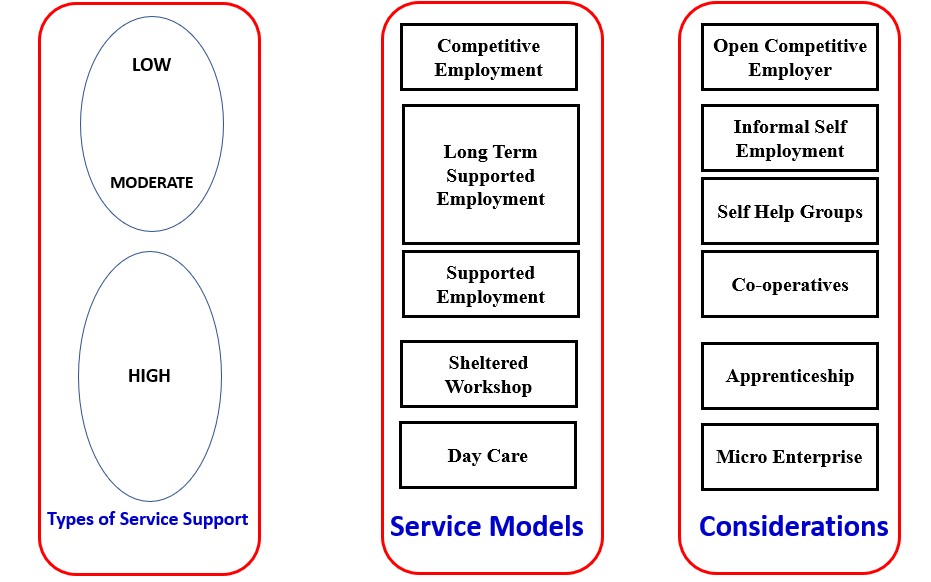
Low and High sheltered Workshop provides an Open competitive Employment. Sheltered workshop refers to a dedicated place where the personnel with disabilities will be working in a nurtured manner. There is no employer-employee relationship here. It requires low support as it is provided as On-the-Job training.
Center based / enclave /home based is a Supported Employment. In an enclave model there is an agency which is involved for supervising the work. This requires high support.
Career Assessment
We never did career assessment as a process for ourselves, it was never part of our routine. Career refers a larger perspective whereas Job is a small part of it. There is a process like Career Awareness > Career Exploration > Career Preparation.
Importance of SDQ
Every one would have heard of IQ which is Intelligent Quotient, however there is something else called as SDQ i.e. Self Determination Quotient/Strengths and Difficulties Questionnaire. How determined you are to follow your aspirations. SDQ is very important for Job placement.
Strategies:
a) Start from day one when a person with disabilities come to you as an infant
b) self determination skills are the key to vocational skills
c) Focus on personal skills
d) Leverage on a natural support system
e) Develop personal future planning or individualized transition planning. (Self Determined Individual Educational Plan)
Foundation / Core Employable Skills:
Literacy – Ability to read/write
Numeracy – Ability to perform basic mathematical calculations.
Communications – Ability to handle Multiple instructions , Sequential Instructions etc..
Social Emotion
Self determinations
Values and Work Ethics
a) Attitude
b) Dependability
c) Flexibility (Ability to work on a holiday/festival day to manage the additional workload)
e) Honesty
Where ? What options ? One size fits for all ?
a) Center based
b) On the Job training or on site training
c) Transitional workshops – certifications
d) Supported Employment and Job coaching
e) Social enterprises ( all forms including SGH )
f) Collective farming ( There is one GST vendor who sells products under their GST, that are manufactured by different vocational units all over. This was done by parents who acquired land on the outskirts and did collective farming. Not all activities need to be initiated by NGOs. Parents can do many things if they can join hands together.)
g) HUB and Spoke mode of employment (Commercial enterprises – section 8)
Types of Service Support
(sharing a rough draft of the image showed during the presentation)
Enclave Model Vs Mobile Work Crews
In an enclave model, a small group of people with disabilities are trained and supported among employees who are not disabled.
Work Crews are supported employment services where a small crew of persons with disabilities are placed in a community for completing a specific task. In Singapore many people with disabilities offer massages to medical staff on fixed appointments, which is the primary source of earning.
For example, Most parents own a car, you can join together to start a social enterprise. That is you can get a contract for cleaning cars in your neighborhood or gated community and involve our disabled children for cleaning the cars. Dignity of labour is very low for us. There is no pride in toilet cleaning jobs, housekeeping jobs etc .. Any job that does not harm any one, done with honesty is the best way to earn.
Kindly do not expect NGOs to do everything as they have a very limited bandwidth. But you as a parent have unlimited bandwidth.
How to make Assessment
1) Perform Job Analysis
2) Roles and responsibilities for that Job profile
3) Workplace Analysis
4) Job Setting
5) Work Activities
Other considerations/Skills required
1) Entrepreneurial Skills
2) Personal Attributes
3) Agentic and Volitional action oriented
4) Business acumen to hand risk and Opportunities
5) Financial Responsibility (It is easy to cheat our kids in money aspects)
My Personal Feedback:
Speaker was highly experienced in placing children in the work environment, she is well versed in the issues that would arise immediately and at a later point of time. Parents of young adults should definitely speak to her and get insights on their children for a better future.
Her session was loaded with a lot of information but I felt it was way too fast. I consider myself to be good at taking notes, but I found it very difficult to capture everything that is happening. Hence this post does not do justice to the points and explanations shared in the session.
I was able to gather only 50% or less of what she said. Must appreciate her determination as she was sick on that day, she honored her commitment and came to deliver her speech. Did a perfect Job, did not compromise on the quality of content that was delivered.
Regards,
Saranya and Karthikeyan
 Autism Spectrum Disorder - Personal Experiences (Chennai Family)
Hi, i found your post so informative thank you very much 🙏
I have a son who’s Autistic . Can I chat with you to have more idea on how my son can get employed in a good job
LikeLike
Hi Madam,
We are glad that you found it useful. We are parents of a younger children, hence we do not have the expertise and knowledge of senior parents who went through the process of getting their child employed.
Any view i share on this will not be factual. You should reach out to senior parents on this topic.
However you can write to us at karthiksaranyaparents@gmail.com.
LikeLike