Hi All,
sharing details of another session which i have recently attended , it was organized by SCAN group. The session details are:
Session Name: Health Matters for Special Needs Children
Date and Timing: 04th Feb 2024, 10 am to 01:00 pm
Venue: The Learning Community at Quest, 3rd Floor, 31B, Rukmini Road extn. Kalakshetra Colony, Besant Nagar, Ch-90
Charges: Voluntary contribution to meet the expenses for organizing the event. No limits were fixed. (Refreshments were provided)
About the Speaker: Dr.K.Lakshminarayanan, Senior consultant, pediatric Neurologist and Epileptologist, Gleneagles Global Health City Perumbakkam and Epilepsy Clinic Nadanam, -Chennai. He is an experienced child neurologist and epilepsy specialist. He has done the following:
M.D.(Paed), D.M. (Paed Neuro) – All India Institute of Medical Sciences, New Delhi
Fellowship in Epilepsy (2 years) – The Royal children’s hospital, Melbourne
Faculty – Asian Epilepsy Academy EEG & Epilepsy course for neurologists
Member, ILAE pediatric epilepsy surgery Task Force
Career Interests – Drug resistant epilepsy , epilepsy surgery
Many publications in reputed journals in Brain Annals of Neurology, Epilepsia
This session was mainly focused on epilepsy, understanding the condition, treatments available, parents psychology towards medicine and side effects, etc. He has been working on the field of epilepsy for the past 10 years. In addition to epilepsy he works on conditions like Autism, Cerebral Palsy, spasticity, etc as well.
The session was not recorded, as it would limit the speaker’s freedom when it comes to sharing certain personal experiences, at times things would be taken out of context and there exists a possibility of misinterpreting certain information exists as well. In this post, i am intentionally not sharing certain information which was discussed on the session due to the reasons mentioned earlier, i.e. to respect the trust and confidentiality he had on us.
Session started a bit late, due to Sunday morning.
Below are the points shared in the presentation:
Of all the neurological disorders, epilepsy is the disorder that is treatable, which became his passion. In addition to this, he feels there is lot more than can be done on treating children with special needs, which is his second passion. 90% of his work is towards epilepsy and treatment of special needs children and the remaining percentage covers areas like Headache, etc.… He believes that by joining hands as a team, we can do better together.
We cannot predict who will get this disorder or not, at this point of time. By and large most of these conditions occur at two time periods, first is during birth (congenital) and the second is during the first 3 years of the child. We cannot change the circumstances in which things have happened, however we can always work towards making the childs life better.
Autism vs ADHD
Most parents who come to him for diagnosis will ask is is Autism or ADHD ? He spend little time to get the correct label, but will not focus too much on it. Most parents do not like to have their child diagnosed under the Autism Label, whereas they are more comfortable to have them under ADHD label.
ADHD is an entirely different condition that Autism. ADHD children will have a good communication, hyper activity will be present. Also ADHD usually starts after 3 to 4 years of age.
In Autism, most children are at pre verbal stage, where they are yet to speak their first words. In few cases there will be need based communication.
Few professionals, out of respite or at parents request provide the diagnosis as ADHD, as they do not want to have an Autism Diagnosis. This is where we are totally going wrong. This will no where help us. As parents, our focus must be on understanding the actual condition which the child has, instead of looking it from a perspective of likeability. In what way, does getting an incorrect label or a likeable label, is going to help in childs improvement needs to be questioned by parents to themselves. Kindly do not give over importance to the labels, but at the same time getting a correct label is equally important as well.
If our focus is on the right direction, we can do a world of good to the child. This is one of the areas where many parents lose their track
Example:
His name is Lakshmi Narayanan, his parents call him Narayanan, all of his friends call him Lakshmi. When he was doing his M.D. in North India, people call him Lakshmi, this set an expectation among his colleagues that Lakshmi is a name that is kept only for Male in south India, as it was not a common name used in North India. After few years, when an actual girl with name Lakshmi joined his team, people were expecting the person to be male, as they were used to link this name to Male till date. The reason for quoting the example is, however you call him, as a person he remains the same. Nothing is going to change if you keep calling him with different names.
Who are special Needs children ?
After careful observation of child development of so many years, we derived a Developmental Milestone chart, which tells the kind of changes and development a child should attain at fixed time intervals. So any child who has an impairment or developmental deviation on Physical, Mental, Intellectual and Sensory would be termed a special children. At the same time a normal child who has an epilepsy will not be considered as special child.
It is not a rare disease, it has became common. Of the 15% of world population, people have some kind of disability. Of the 15%, major portion of them are children.
Categorization of Special Needs Children
Children with Physical impairment can have:
1) Muscular dystrophy 2) Multiple sclerosis 3) Chronic Asthma 4) Epilepsy
Children with Developmental impairment can have:
1) Autism 2) Down Syndrome 3) Dyslexia
Children with Behavior impairment can have:
1) ADHD 2) Bipolarize 3) Oppositional defiant disorder
Children with Sensory impairment can have:
1) Blind 2) Visual Impairment 3) Deaf 4) Limited Hearing
Common Types of Disorders
Autism – 12.9 %
cerebral palsy – 11.4 %
Down Syndrome – 5.2 %
Encephalopathy – 2.6%
Epilepsy – 10.2%
Intellectual Disability (earlier called as Mental Retardation). – 41.5%
Other Disability – Attention-deficit/hyperactivity disorder, learning disability, Hearing, Vision – 19.8%
If a child has more than one disability, they will be termed as Multiple Disability which is a separate category. They fall under the Other Disability category mentioned above.
Potential causes of these disorders are:
1) Prenatal – Birth complications such as child did not cry after birth, oxygen did not reach the brain, any infection that could cause brain fever, Brain Hemorrhage etc.. which are common and a major reason
2) Genetic
3) Parental Age
4) Brain Malformation – The very structure of the brain itself is different.
Intervention Possibilities are:
We need to know whom to approach for what:
1) Medical Treatments ( Medications )
2) Behavioral Treatments (ABA, counselling, other psychological interventions)
3) Learning aids (Special education)
4) Mental health (Psychologist and psychiatrist counselling and medicines if required)
5) Developmental (Therapies)
Cure vs Care
Whether a disease/disorder can be cured or the impact it shall cause, can be reduced or not depends on the disease. Most parents totally give up when we say a particular disorder cannot be Cured, however it can be managed to the extent possible by providing required care.
When we say, we cannot cure a disorder, it does not mean there is nothing that can be done towards it. We can bring in many improvements by providing certain care.
Example:
Recently he met a child with Muscular dystrophy who has been getting regular treatment from reputed medical facility, the medicine which the child consumes was working well. In most cases of Muscular dystrophy, the child will not be able to walk from certain age i.e. say 8 years. Through medicine, we can extend that age ceiling to 15 years. Parents have stopped the medicine for last 6 months, did not have follow up checks ups, one fine day they came to visit me. The child was 12 years old, completely normal child, his understanding and intellectual skills were age appropriate, since they discontinued the medicine for a time period, now the child cannot lift his hands beyond elbow level. The medicine has the ability to prolong the life time and contain the illness from spreading across to further parts of the body.
As a parent, we are emotionally connected to the child, we do not see Doctor giving medicines to save the child, we only see Doctor giving steroids to our child which is know to cause severe side effects. As a parent the focus is only on the side effects which the medicine may or may not cause, and never on the benefits that it will definitely show up on the child. As a parent, you are thinking that by stopping a medicine you are doing good to the child, but actually you have done more harm to the child.
There are different angles to a suggested treatment. If we kept looking at it only from emotional angle, it will not be of any help to the child. We must learn to set aside the emotional stand point and view the treatment from all others angles to understand why it is suggested. This is called Informed Decision Making process. When a child has certain issues/needs/symptom, which is preventing him from getting a particular intervention, for a temporary period of time by providing a medicine, we can mitigate that particular issue or need or symptom, which shall allow the child to perform better. As a parent if they have an open mind to try it out for few months to see the results, the child is only going to benefit from it.
When we say we cannot cure, it also means that we can improve or manage many symptoms that come with the disorder, which shall improve the quality of life of the child and his family.
We say Autism cannot be cured, but at the same time children who are diagnosed with Mild autism with good or normal IQ have became normal/Neurotypical. We can only call this as Cure. So in case of autistic children, few can get the cure, few can get improvement, from their present condition. We should understand this distinction, instead of making generalized statement “Autism cannot be cured”. Also the statement “No Cure” is made from the disease perspective and not from the treatment perspective. If a condition cannot be cured, it means that it cannot be cured though any other form of medical interventions, it does not mean that there is no cure available in Allopathy alone or any one specific form of medical intervention. The perspective is from the disease and not from the medicine.
We are absolutely fine with patients trying alternative treatments, as everyone wants their child to be better. But the selection of treatment should NOT be based on false claims, 100% cure, immediate betterment, experimental treatments, etc. Parents should think rationally instead of emotionally before making the choice. Most parents do not want to keep the condition in control, they are only after CURE. Due to this mindset, for a child who never had seizues for few years , parents will decide to try an alternative treatment in the hope of permanent cure. This will often result in discontinuing the allopathy treatment and continue with alternative treatment, a sudden stoppage of medicine which is keeping the condition in control, will cause an impact to the body. We had more such patients ending up in ICU in critical condition on a daily basis.
Consult with the doctor before discontinuing the medicine, know the withdrawal impacts, be prepared, or discontinue it in gradually, to mitigate the impact.
STEM CELL
In his practices, he has never seen any children with neurological disorder being benefitted from availing stem cell therapy till date. Stem Cell is still an experimental treatment, one can do it as a Clinical Trial. It is not a proven therapy/treatment model that is going to bring improvement to everyone who undergoes it. It cannot be treated as a routine treatment. There is an element of commercialization that is attracting more people towards it.
Brain is an entirely a different organ, which will not benefit much from stem cell therapy. However it can be an effective treatment on fixing liver or other organs.
Most parents avail this treatment option, as they have concluded that nothing else is going to work on the child, why not try this option as well OR they try it out just because some other parent know to them have tried, they need to do it as well.
We still do not have long term data on this, as to how people who availed this treatment are living a healthy life or not.
DIY Approach
In todays world, most parents have the mentality that they will learn about the disorder, they will find the treatments available, and they will provide the treatment by themselves to the child in order to see an improvement. This may hold good on different fields, but this is not a right approach in the field of medical interventions.
We tend to apply the DIY attitude to everything. You buy a furniture that comes with parts that needs to assembled and a instruction manual, you follow it to arrive at the end product which you wanted. His kind advice to all parents is do not take the DIY approach to medical treatments. As a parent you are emotionally connected to the child and you are exposed to one aspect of the illness or the disorder, whereas a medical professional has seen multiple patients with various severity levels, they know what actually works than what is written in their published medical journals.
For Example, assume you have 10 lakhs in your hand, you want to invest it. If you try to do the investment yourself, there exists a possibility that you may loose all at one point of time. You need an expert to help you in making the investment according to your need, like a retirement benefit scheme, mutual funds etc..
Similarly, if we think that doctors are only going to do what is mentioned in the medical text books or in google, then we do not need a doctor. Doctors get to make a call i.e. professional judgement based on the different scenarios they have seen over years of experience, which lets them decide what suits best for this patient, which you may not find in any medical texts because, the medical texts are generalized, but the treatment suggested by your doctor is customized according to your illness, hence there will be a difference if you compare the approach, but from results perspective the cure is guaranteed. After working for so many years, individual patients differ, we can never make a generalized statement about a treatment that all apply to all.
Right Philosophy
- Keep it Simple
- The child can only become better from the current stage, if you follow the treatment protocols
- Certain aspects of treatment has to be done in the exact specified manner. (As doctors, we have navigated through various possibilities and found out which particular path has a higher success rate, hence we suggest that proven path to patients along with navigations to reach the milestone which is betterment.)
- Family education and Family Involvement in Therapy
- Focus on the next immediate milestone.
- Do not loose track/direction
- Focus on aspects that are in our control.
What Google provides you
A medical treatment cannot be prescribed in a matter of 10 mins through google. A medical treatment provided by a Doctor uses 4 components, i.e. Data, Information, Knowledge and Wisdom. Google can only provide Data and Information, may be knowledge on some occasions but it cannot provide wisdom. We need to know whom to approach for what. For collecting data and information, google is the right place. Never let the opinion of others control your life, for they are only a mere reflection of their own experience, beliefs and perception. Take only what is productive and useful to you. Do not allow others to make decisions about your life. We need to be very clear about what we want.
Realistic Expectation and Goal Setting
- Individualized Plan – Not all autistic person are same. Not all epileptic person are same. There are so many differences between every individual.
- Short term vs Long term goals. – If you fail to achieve your short term goals, you will never be able to achieve long term goals.
- Focus on the Immediate future – What can be done for the next 6 months is the immediate future instead of thinking about what would happen after 10-15 years from now.
- Split tasks in to smaller tasks – When faced with complex tasks, split it in to smaller tasks.
- Keep working towards your goal everyday
- Periodic Assessments – Follow up is extremely critical as these interventions are not one time interventions. Regular assessments help to find out re-assess the goals and plan accordingly. People tend to avoid follow ups or re-assessment, because it is not going to change the diagnosis, hence parent does not show interest in it.
- Replan and Set another goal
Gap between Expectations and Reality:
- Expectations should match the Reality. Work to improve reality while also adjusting your expectations.
- If you keep having unrealistic expectation and constantly hoping, that will lead to chronic unhappiness or health problems for the caregiver.
- You cannot keep doing the same thing every day and expect different results. If you need a different result, your strategy should be different.
- Life is Simple but not easy is the most popular quote, but from personal experience i would say Life is not simple, it is extremely complex and complicated, but we can keep our lives simple. We are the reason behind most of the problems we are facing. If we stop creating those problems, life becomes more simple.
MINDSET
You can reset your mindset, which shall solve so much of our problems. The nature of Mindset can:
- Can be Transcended
- Habits of Mind
- Created by Experiences
- Are self Deceptive
- Shapes our lives
- Shape our world
- Can be developed
Wholistic Development
A ladder with Smaller steps is much easier to climb, similarly little progress every day adds up to big success
Multi Disciplinary Approach
1) Medical
2) Nutrition
3) Occupational Therapy
4) Speech and Language Therapy
5) Physiotherapy
The treatment will be multi disciplinary on many occasions. If you take Cerebral palsy, there is a possibility of wide range of treatments like Medicine, Intensive physiotherapy is possible, surgical interventions are possible, local botox injections can be administered, etc.
Medication Treatment
There are few issues which we cannot resolve without providing Medicines. As a parent if you are resistant to availing medicines, then it becomes impossible to see any progress. We need to have an open mindset. Most people are so much resistant to medicines, that they do not want to hear the benefits and does not even willing to provide a chance to the Doctor or the child.
Every medicine is prescribed after doing a risk benefit analysis for that particular patient. When the risk is way too low, the focus should only be on the benefits that the medication can provide.
In below scenarios, medication treatment helps:
- When the benefits outweigh the risks
- Movement disorders such as Spasticity, Dystonia, Tremors, Ataxia, Chorea, etc.
- Seizures
- Hyper activity and Bad Behavior
- Insomnia, Unregulated sleep.
He shared couple of such cases with videos:
Case 1 = Where a child who has a severe dystonia (Neck falling back) was initially prescribed for DBS (Deep Brain Stimulation). He became much better purely after the medication treatment.
Case 2 = He shared a patient condition, who cannot stand properly due to severe spasticity, we were able to achieve improvment using simple intervention. We can do simple interventions, intense interventions, can provide oral medications like baclofen, based on the condition.
In case of physiotherapy, parents cannot provide this to their children at home. It is a dose concept. Like how 5 ml of medicine will solve an illness, a therapy technique need to be done in a particular fashion to see the results. Similarly any therapy that is performed at home, the parents will not get the dosage right. It has to be done by the professionals to see the results.
5 R’s
Right patient > Right Drug > Right Dose > Right Time > Right Route
Family therapy
Whole Family should be involved. Only mothers are involved, the rest of the family is nowhere involved. We see so many kids improve a lot when there is a family support. Majorly mothers are burdened. When one person/caregiver is performing all around the child, the caregiver burnout is very real. Family are the primary source of care, nurturing and support for children with disabilities.
Catch Them Young
- Early Identification of Issue is important: As many parents come to professionals around 6 years of age, after receiving so many complaints from school. By that time all crucial period of development is already lost. There is no harm in getting a consultation. Parents are so much scared of what the diagnosis is going to be , as a result they totally do not do the diagnosis at all, which impacts the child very much. The more you delay, the very less we can do to the child.
- Early diagnosis
- Paves way to Early Intervention
- Crucial time is saved
- Golden period of development
- Better Outcome
Hence kindly do not “Wait and See” always act early.
Package of Interventions
Based on years of experience, we observed below combination works without a doubt:
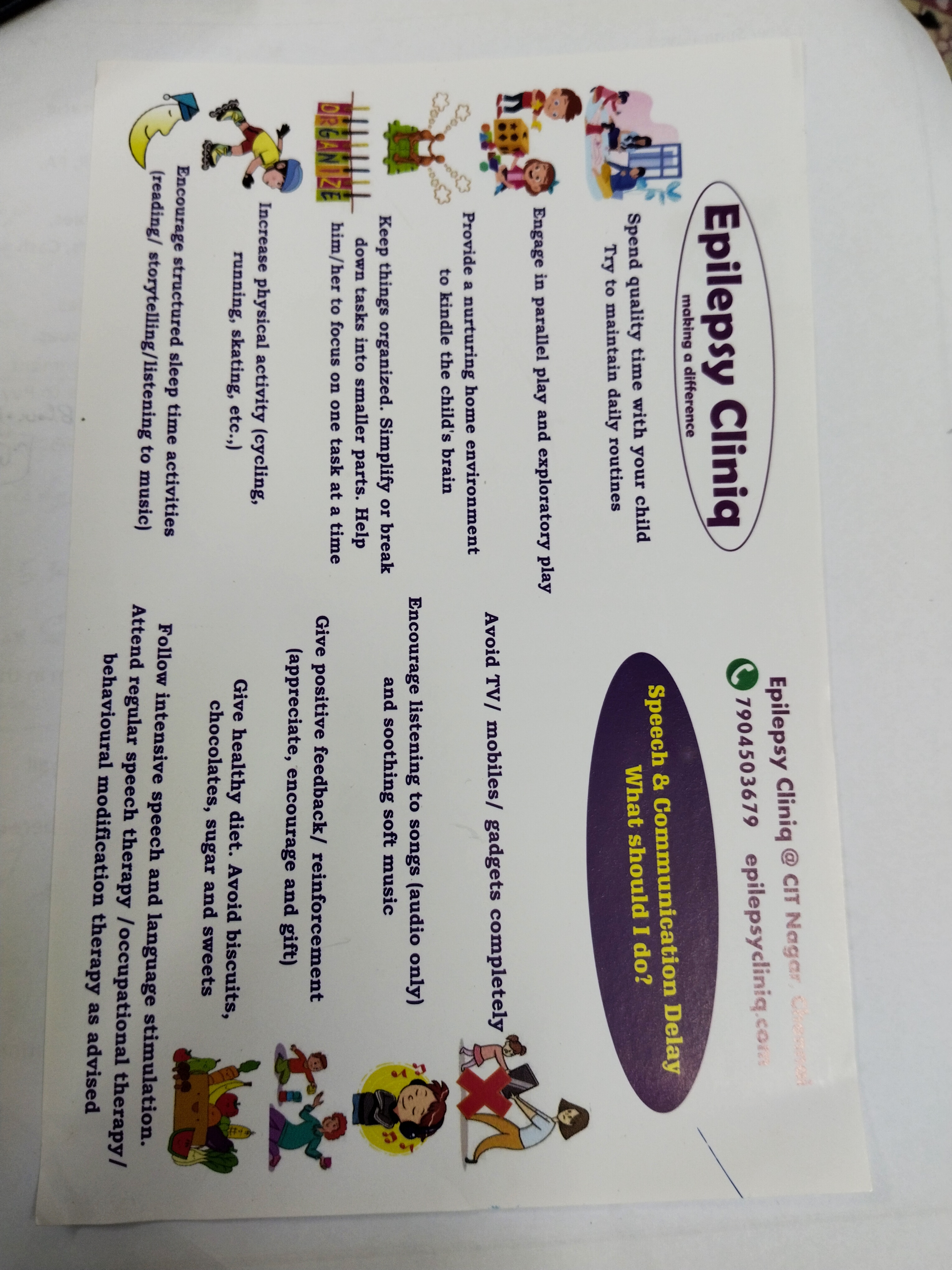
- Remove TV, Zero Screen Time
- Avoid added Sugar
- Physical Activity
- Regular Sleep
- Occupational Therapy
- Speech Therapy
- Home Program
- Play Group
- ABA Therapy
- Development and Play Therapy
- Sensory Integration Therapy
- Special Preschool
Needs of Slow Learners or children with learning disabilities
- Special Coaching
- Repetitive Practice
- Counselling
- Auditory, Visual Learning Aids
- Empathy from Others
- Needs to feel belonged and Included
- Friendly and Non Judgemental attitude of teachers
- Immediate Feedback
- Special Motivation
- Extra time allowed in exams
How to handle Behavior Problems?
- Do not focus on negative behavior
- Do not overlook your childs triggers
- Do not give multiple or vague instructions
- Do not overuse negative instructions
- Do not assume your child is aware of the consequences of his behavior
- Do not overlook the power of positive reinforcement
- Do not treat everything as a battle
- Do not lose sight of your objective
- Do not overlook the power of connecting with your child
- Do not forget that there is no “one size fits all” discipline strategy.
10 positive ways to Discipline:
D is for Distracting
I is for investigating Needs & Feelings
S is for Structuring the environment
C is for Consistency
I is for Instructing
P is for playing & connecting
L is for Limits
I is for Ignoring
N is for Noticing Positive behavior
E is for excusing self or the child
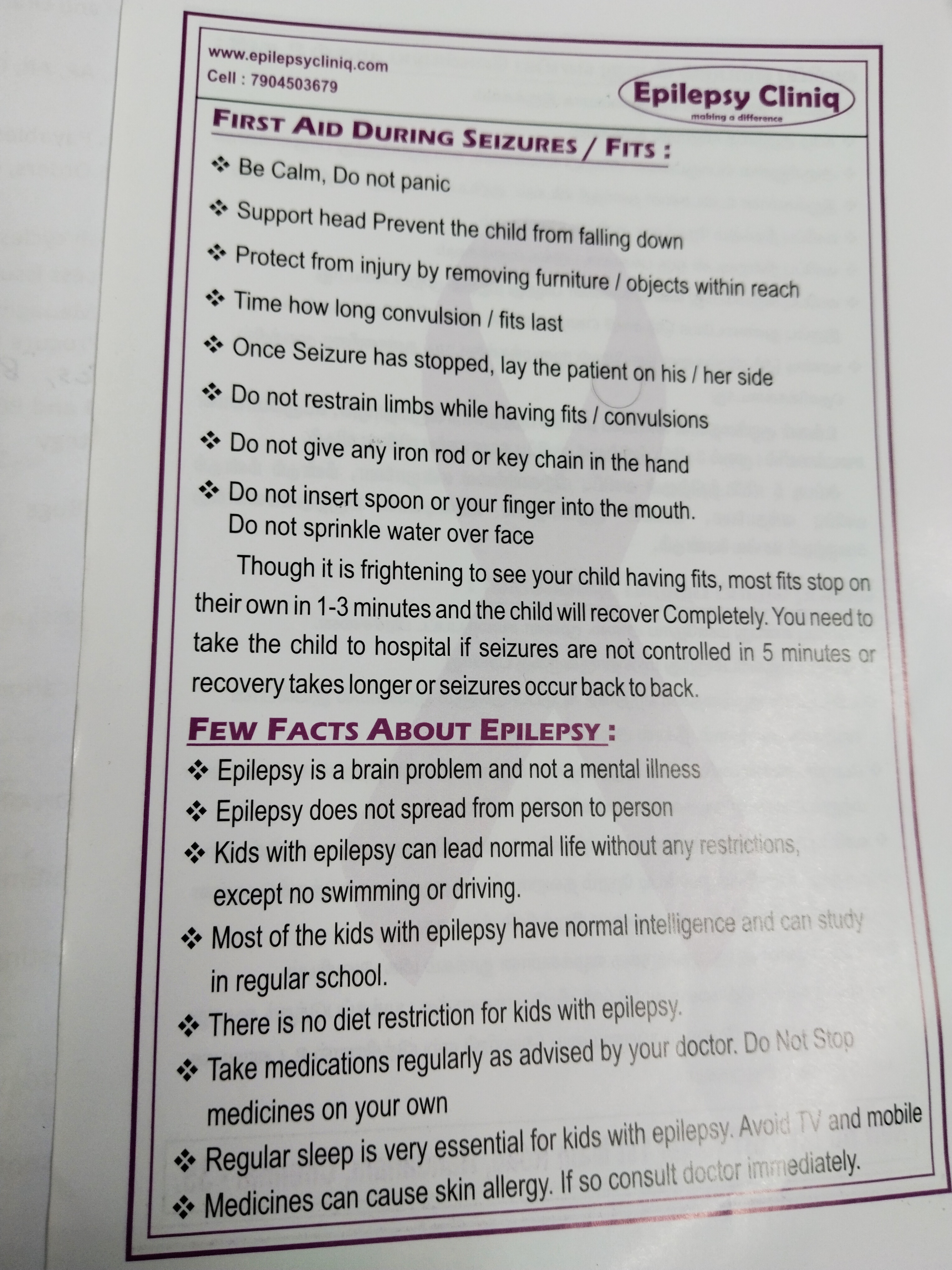
Seizure First Aid:
- For 95% of the children when the seizure occurs, it will stop by itself. No action required from our end.
- As a caretaker, we should only ensure that child should not fall down, get hurt or injured considering the place where the seizure happens, apart from that no action is required.
- Fits can never be stopped, it can only stop by itself. As a Neurologist who is an expert in Epilepsy, if one of you have a seizure in front of me, even i cannot do anything to you, i will only wait till the seizure stops by itself. I cannot do any magic to stop seizure.
- Time the Seizure, If the seizure does not stop within 3 minutes, then call an ambulance.
- The suggested posture to lay down after the seizure stops is the left lateral position. It is the recovery position.
- Stay Calm
- Keep the Area Safe
- Get Help
- Put something soft under their head
- Do not give water. Do not splash water on the face
- Biting tongues during seizure is common (Even a strong bite to a tongue will get healed in 2-3 days)
- Do not place fingers/cloth/Spoon on the mouth. (More problems can be caused with these interventions)
- The seizure that lasts longer can only happen, when there is no proper sleep or sudden stoppage in the medicine, high fever etc.
- There are different types of seizure, which can be presented longer than 3 minutes will not cause any issue like absence seizure. There is no struggle to the body.
Effect of Media on Kids
1) IKEA Plant experiment done in UAE.
Where two sets of plants are kept in two different locations, where one group of plant was praised by others, and another group of plant was abused, scolded, shouted at. At end of the month, the plant that was not praised lost its growth. If a matter of 30 days of negativity can take away a life from the plant, imagine what would happen to our kids with their screen time during their lifetime. We should speak positive towards our children and be cautious about what they watch on TV/Screen daily.
2) Frog 2022 experiment
A group of frogs who were watching Mobile with their eyes glued, when a human hand approaches to take away the screen, the frog became aggressive towards that person.
It is so addictive.
Social Evil
- People consume three times as much information daily as they did in 1960
- 61% of people cannot ignore their electronic devices, They check them within the hour after getting an email, text or alert
- 50% of people check their work email outside of work hours, including weekends and vacations
- 61% of people have felt jealous, depressed, sad or annoyed after checking updates on their social media account
- 81% of people admit to interrupting conversation, mealtime or playtime with family or friends to check their social media, text messages or email.
- 3 out of 5 people spend more free time on their computer than they do with their significant other
- 73% of people believe their use of electronic devices has contributed to stress in their life.
Virtual Autism:
This is purely caused by excessive Screen time. We started seeing this especially during the Covid lockdown period. Kids with screen time exposure between 1 year to 3 year of age have 4 times of higher chance of getting diagnosed with Autism. The symptoms are:
a) Hyperactivity
b) Inability to Concentrate
c) Absence of enthusiasm for Playing outdoor
d) Lack of Interaction with others
e) Irritable and Erratic Moods
f) Reduction in Cognition
The risks of too much screen time
- Stunted Brain Development
- Weight Gain and Obesity
- Exposure to Inappropriate Content
- Exposure to advertisements
- Eye Strain and Headaches
- Poor Sleep
- Poor Performance in School
- Less Socialization
- Poor Vocabulary, Verbal Fluency
- Poor writing ability/grammar
- Lack of creativity and imagination
- Poor social skills
- Detest human interaction
- Isolated, no friends, withdrawn
- Not Playing outdoors
- Early maturity into adult thinking
- Lost childhood
Effects of excessive sugar intake:
- Memory Loss
- Depression
- Fatigue
- Obesity
- Anxiety
- Insomnia
- Mood Swings
- Hyperactivity
Sleep your way to health:
Effects of Sleep Deprivation:
- a) Central ( Cognitive impairment, Memory Lapses or Loss, Impaired Moral Judgement, Severe Yawning, Hallucination, Symptoms similar to ADHD)
- b) Lymph Nodes ( Poor Immune System Function)
- c) Pancreas (Risk of Diabetes Type 2)
- d) Heart ( Irregular heart Rate, Risk of heart disease)
- e) Muscular ( Aches, Tremors, Decreased reaction)
- f) Other ( Growth Suppression, Decreased temperature, Risk of obesity)
Best Sleep Hygiene Practices
- Go to sleep and wake same time
- Mediate for 10+ minutes prior
- Create a bedtime routing
- Switch off devices 1 hour prior
- No stimulants after lunch
- Avoid large meals close to bed
- Get enough exercise through the day
Problems faced by Parents and Families:
- Lack of Family support
- Not many special schools, Residential schools
- Inclusive schools are only inclusive in their name, but not in their services provided
- Right to Education is still only on the paper and not enforced.
- Lack of Training and awareness in mainstream school
- Special children and discrimination everywhere
- Society at large excludes them
Care giver stress:
- Easily Frustrated
- Forgetful or Foggy
- Quick to anger
- Extreme Tiredness
- Anxiety or Depression
- Hopeless or Helpless
- Uninterested in things that they used to love.
Care giver burnout
- Neglected Topic
- Taboo to discuss
- Most families – Ignorant and Non receptive to talk about
- Taken in negative connotation
Most common issues of caregiver burnout are:
- Unhealthy eating patterns
- Unusual weight change (gain or loss)
- Poor Sleep Quality
- Feeling tired all the time
- Feeling down and unhappy
- Feeling stressed and easily irritated
- Failure to maintain social commitments and relationships outside of work
- Loss of interest in non work related activities
- Neglecting physical symptoms and failing to seek medical care.
Coping with caregiver burnout
Main causes:
- Prioritize the needs and interests of their loved ones
- Have unrealistic expectations
- Lack of support from family
- Juggle Multiple commitments
Signs of Burnout
- Anxiety, depression
- Constantly feeling exhausted
- Neglecting your wellbeing
- Falling sick more often
- Changes in sleep patterns
- Changes in appetite / weight
Prevention Tips
- Set realistic expectations
- Embrace your role as caregiver
- Practice self care
- Join a caregiver support group
- Take regular breaks
- Relax and meditate
How to get a maximum out of a Doctor’s consult
- Take all the relevant reports to the Doctor, hard copies
- Be organized, organize your thoughts, give proper history
- Answer doctors queries to the point
- Do not fiddle with your phones
- Listen well and focus when doctor gives you advice and instructions
- Ask questions clearly, have focus and concentrate
- Don’t try to counter everything
- Don’t cross check with google
- Write down your queries
Take home messages
- Early diagnosis and Early interventions
- Seek Care Early
- Accept and understand the diagnosis (Parents spend way too much time with multiple assessments with different professionals with the hope that some one will give a different diagnosis, instead of Autism. They are wasting the crucial golden period where early intervention works)
- Follow the most proven pathway
- Regular Follow up
- Together we can do more
RESPONSE TO PARENTS QUERIES
Q – In most cases, parents are afraid to ask the Doctors about their queries related to either stopping medicine or trying alternative treatment (like ayurveda, sidda, etc.)
A – I agree. The reason behind is that most parents come to doctors after deciding everything, they do not consult doctor in the decision making process to find out the pros and cons of the present approach that is being followed when compared to the alternate treatment that they are planned to avail. In all cases, they come to doctor just to inform the decision they have already made and not to ask for opinion, this does not go well with most doctors.
It depends on the Individual and how they perceive the information. He quoted a personal experience where, there is a child with Autism and Fits. Fits has been in control for last 1 year and above. The parent saw a youtube video, where it was mentioned that visiting a particular temple and doing certain ritual will cure autism. The temple was 400 kms away from Chennai. The parents began their journey like 3 am , visited the temple, performed ritual and again began their travel back to Chennai on the same day. Due to the hectic schedule, they forgot to provide the morning dose for the child. No one is against going to temples or any faith, but think rationally. Travel one day, visit temple another day, and return back another day.
Q – One of our family member got epilepsy at 17 years of age suddenly. What could be the reason for it? Since it was during Covid times, there was increased amount of online classes that was being attended to, which resulted in less sleep, could that have caused the issue ?
A – All diseases comes suddenly. Had a colleague who is a marathon runner, passed away due to cardiac arrest. There can be a reason for few cases, but we always cannot pin point a root cause for an event all the time. We need to understand the difference between Trigger and Cause.
When some body says that they had a hectic journey schedule after which they got a seizure, it does not mean that Travel has caused the condition, it means travel has triggered the condition which was already present. Similarly sleep deprivation is a trigger and not a cause. It does not mean everyone who is sleep deprived will get seizure, it means that the personal has an epilepsy condition in his body, the sleep deprivation has triggered it on that particular occasion. Also it does not mean it will happen only during this particular trigger.
Most common cause for this issue is either Genetic or no cause. In most of our patients, MRI will be normal, genetic testing will be normal, eeg will show what kind of epilepsy the patient has, it does not provide you the cause. We cannot find the cause on most occasions.
Q – Is it true that one of the side effects of consuming medicine is gaining weight ?
A – There is half truth to it. The medicine will stimulate your appetite or make you feel hungry. Now to satisfy the hunger if you began eating junk food all the time, then ultimately it will result in weight gain. If you avoid going out completely and spend most of your time watching TV, then you will put on more weight as well. Before starting medicine, the advice which doctor provides to everyone is:
1) Avoid Junk Food
2) Make phyiscal activity part of your everyday routine
3) Hyderate yourself
4) While eating focus on the quantity, to avoid over eating.
If you follow the above while having medicines, you will not have a significant weight gain.
From my professional experience, i would say that “side effects of Epilepsy” medicine is overhyped. The side effects are not to the extent as people claim it to be. Also we are consuming the medicine NOT by setting aside other alternative treatments, we are consuming this medicine as we do not have any other choice as of now. So whether to consume a medicine or not, is never a question here. The doctor decides the right medicine based on the type of epilepsy and also he decides the dosage based on the child. Every medicine has a suggested lowest medicine levels, in that for that particular child the dosage that a doctor could suggest can be even lower. This is where expertise comes in to play. Also practically not many get side effects at all.
For example, every one has consumed paracetamol, if you look up the side effects of the drug, from moderate to severe there are various side effects listed. We have overused this drug on many occasions, how many of us have encountered the side effects that was supposed to happen. In short, side effect is a theoretical possibility, it happens to a very lower percentage of people.
Q – How about kids below 5 years, who get fits due to high fever ?
A – For fits that is caused due to high fever, most likely it will never happen again after 6 or 7 years of age. They are called as Febrile seizures or Fever triggered Seizures. A very smaller percentage of kids only get it later on as well.
Q – Who can do the assessment for our children ?
A – Primary specialist is the person who should do the assessment. In case of Autism, Primary specialist can be either pediatric neurologist or pediatric Psychiatrist. It cannot be done at a pediatrician level. Developmental pediatrician can do assessment as well. Different problem needs Different doctors.
Q – What happens when the child turns 18, should we continue with the Pediatrics specialist or have to change to an Adult specialist of the respective specialization ?
A – Outside India it is mandatory that if a patient is 18+ years old, they have to consult only Adult neurologist. There exists a Transition care during this phase where the child will get to consult pediatric and adult neurologist for a brief period of time. But in India the rules are still not standardized, it is mostly left to the Individuals choice.
Q – What about placing keys in the hands of the person during seizure?
A – It is purely a superstition. If keys are going to fix the seizure all the time, then every person prone to seizure can carry a set of keys all the time with themself and totally avoid medication for fixing it.
Q – Why swimming is restricted for the kids with seizures ?
A – It is not that swimming will trigger a seizure. If a seizure happens during the swimming activity, it will take a matter of 5 to 10 seconds for the kid to drown, hence it is restricted. Even if you are an expert swimmer you will drown quickly when you get seizure when you are on the pool. If you have a dedicated coach or specialized instructor or a parent who is going to keep his eyes on the child all the time, then they would be able to pull out the child in time.
Q – Is it true that kids with autism has a higher chance of seizures during teenage / adolescents ?
A – Yes it is True, they have a 30 to 40% possibility during the hormonal changes.
Q – Most Schools tend to push away students with seizures or with special needs around 8th or 9th standard, it is disheartening to see it happening at Private as well as Government schools. What can be done on this ?
A – From medical perspective, by following seizure prevention control practices, we can bring it under control. Once it is on control, they can pursue school. This is a common issue in many schools, they ask the parents to cure the child first and then bring them back OR they make situation worse for the child or parent, as a result parents are forced to leave the school indirectly.
As a doctor, i know all kids with seizures can go to school all the time, even if they get a minor seizure in school, nothing will happen to the child. The body is not going to respond differently just because the seizure happened in school instead of home. But the school asks the parent to cure the child permanently and bring them back, which is purely a lack of awareness from the school side. I have tried from my side in making the school understand about epilepsy, but they are not receptive. The pressure that is faced by school now a days is beyond 100%, they are in a competitive market. The focus has shifted from betterment of the child long back. When we do not have the receptiveness to listen and learn new ideas, as a Society we are failing.
My personal feedback:
This was my first time listening to Dr.K.Lakshminarayanan, he is very soft spoken and polite throughout the presentation. He was at ease in answering all questions raised by participants. He spoke very good Tamil as well. The slides were planned in a proper sequence, the content was not overwhelming, the explanation was done in such a way that every one can easily understand. He used examples and analogies wherever required, to ensure that we clearly understand what he was trying to convey. He did not made any attempt to conceal or misguide the parents at any point of time, he provided all factual information.
It was very interesting for me to listen to him, as he spoke so much about issues that are faced by a caregiver / parents, he had such an amazing clarity on what parents are going through. Most medical practitioners will limit sharing their views only to medical aspects, however he had a very clear view from what parents, family members, schools , governments etc. should be doing. Such a view can only come, if a person has connected to many families at a very deep level and also showed a sincere interest on their struggles.
It is so much assuring to see doctors reaching out to parents at large to make them aware of issues that are out there, which can be resolved if we take right decision at right time. Need more such sessions from medical practitioners of different specialty.
Sharing the pamphlets which was shared at the end of the session:

Regards,
Saranya and Karthik
karthiksaranyaparents@gmail.com
 Autism Spectrum Disorder - Personal Experiences (Chennai Family)
Hello,
My kid is 4 yrs old, we got him diagnosed for ASD when he was 2 yrs. We are planning to take up a proper assement to knw the exact scenario, I just went through your blog of SRMC, knowing it was not a pleasant experience.. any hospital in your suggestion ?
LikeLike
You can do assessment in Niepmd as well. With respect to my review in SRMC, it is purely related to my experience with them. It does not mean that every one who goes there will have an unpleasant experience. Also you can get assessment done by professionals directly as well instead of visiting a hospital. If you are assessing for a formal report to be submitted to school or some other place , then Niepmd is a better choice. If you are looking for an assessment to find out the current level of the child and see which areas require more attention now..for that get assessment by specialists separately..
LikeLike