Hi All,
sharing details of another session i was able to attend yesterday. This was organized by SCAN group. For most of the development delays/disorders, the common denominator has been sensory processing issues, however its strange that no one ever thought of
organizing a session to throw more light on this, until today. SCAN organized the session on sensory Integration, the session details are:
Session Name: Workshop on Sensory Issues relating to ADL (Activities of Daily Living) Training
Date: 13th August 2019
Timing: 10 am to 12:30 pm
Venue: Mitr, T-18/2, Coastal Road, Kalakshetra Colony, Besant Nagar, Chennai – 90
Charges: 150 Rs per Person ( Refreshments were provided)
About the Speaker:
Mrs.Lalitha Sridhar is a rehabilitation consultant and developmental therapist specializing in sensory integration and neuro developmental therapy. She is an educator and counselor for children with development / special needs and their parents. Lalitha
has over 30 yrs of experiences in India and abroad. She has worked with children across all age groups, from early intervention to vocational training and has been providing programs across age groups. Her core areas of work are assessment, intervention and developing holistic programs for children with special needs. She has worked with parents in guiding, training and empowering them in their journey.
The session must have started on time, i reached 10-15 mins late, the session was in progress. She requested not to voice record the session, as the focus / attention / interaction would get lost. She did not mind taking photographs . Below are the details shared in the session based on whatever notes i could gather:
WHY DO WE NEED SENSORY INTEGRATION ?
For any Development and Learning to happen, Sensory Integration is the first thing that should be in place. A child/Adult will only come know what is happening around him through his senses. Brain perceives what it perceives from the senses. Any information that is going to reach the brain, will only be through the senses.
For example,
She asked “What comes to your mind, when you think of flower ROSE and provide a single word answer …..?”
Participants answered “Color, Fragrance, Beautiful,etc..”.
She said, even though the object ROSE is same in front of every one, why all of you did not give the same answer. Each one your senses work in a certain way.
Development and Learning are two different things. Development is primary and Learning is secondary. If there is a lag in development, there will be difficulty in learning. Development (வளர்ச்சி) Learning (கற்றல் )
CLASSIFICATIONS OF SENSORY INTEGRATION
Sensory Integration can be classified in to three parts:
a) External – It refers to your external receptors such as Touch (Tactial), Taste (Gustatory), Smell (Olfactory) and Sight (Visual) and Sound(Auditory). Of which Touch, Taste and Smell are near senses and Smell and Sight are far senses.
b) Within Body – If refers to Vestibular (Awareness of body) and Proprioception (Focus on Joints and Muscles) senses.
c) Internal – These are receptors that are in the organs. For example, when you say I am Hungry, I want to go to Toilet, what actually happens is that your Stomach i.e. an organ acts as receptor and sends information to the brain, brain then sends the information to the muscles where an motor activity takes place for you to eat. Similar thing happens for Bowels and Bladder. If there is a dysfunction in an organ communicating to the brain and as a result a motor activity takes place, you will not reach anywhere even if you put in lot of effort. Every sensory input corresponds to an action. Every sensory integration should have a motor function along with it. For Example,
You feel Hungry > Stomach is the Organ that sends the sensory input, hence this is a sensory Component
You are eating > You have to use your hands to eat, control yourself not to mess up the area while eating, and decide on how much to eat, all this resembles a Motor Action.
Enough has been spoken and discussed widely about the other senses, hence she focused only on the key senses that needs better understanding:
Sense of Tactile
a) Bonding and Attachment – Touch sense is very important for Bonding and attachment, in turn for an Emotional Development. Emotional development is important for Adults as well. We have to raise our child to be able to manage it, being rich and successful means very less when compared to this.
b) Gives us Body Boundary – Where is latha sitting ? without the sense of touch, you will not feel this boundary.
c) Mouthing and Hand Skills – Activities like Brushing, Feeding etc .. Also needs to check if Mouthing and Hand Skills are working together and also separately as well. As it helps in identification of Pre-vocational skills.
d) Protective Function – Hot, Cold, Break or Fall, Self Protection, Self Help, Security etc … It is also an Motor function.
Sense of Proprioception
a) Maintain Alignment of Body Parts – In order to pick up a pen from the ground, you have to bend your back, your elbow needs to stretch, your fingers will grab the pen, your head needs to tilt etc ..Alignment of so many muscles need to happen in order to pick a pen. Similarly in order to maintain body alignment certain muscles needs to be contracted and some needs to be relaxed.
b) Control of Movement – How much of movement is required needs to be known.
c) Precision – It refers to accuracy in movement. She mentioned the Finger to Nose test is a good one to try out (Refer http://www.clinicalexams.co.uk/finger-to-nose-test/)
d) State and Steady Level of Alertness – Sense of alertness is important. For any learning and development to happen, steady state level of alertness is required.
Sense of Vestibular
a) Emotional Security via Gravitation – Gravitational pull gives an emotional security. We cannot be in a steady state without the gravitational pull. When there is no gravitational pull, muscles are working against gravity. For example, assume if the kid thinks that he is going to fall any moment, he will not feel secured.
b) Balance and Protective Reaction
c) Anti Gravity Posture – Complex movements will develop only when anti gravity posture develops. Sitting, stating, walking, picking up a pen, all are examples of activity against gravity.
d) Stable Visual Field – When you point your finger towards a direction / object, the children should see that direction. All aspects of the physical environment that can be perceived by a stable eye at a given moment.
e) Bilateral Motor Co-ordination – It is the ability to do two things at the same time in an organized manner. Mid line crossing, Climbing steps, cycling, swimming, Marching ( Only Hands, Only legs and then Hands with Legs), Upper body co-ordination with lower body, Right side body co-ordination with left side body etc …
BRAIN
Brain, some times it runs too fast .. some times it runs too slow.
a) List of activities where brain acts “Too Fast”
i) Too Anxious
ii) Excited
iii) Stressed
iv) Frustrated
v) Angry
vi) Hyperactive
b) List of activities where brain acts “Too Slow”
i) Drowsy
ii) Sleepy
iii) Lazy
iv) Tired
v) Day Dreaming
c) List of activities where brain acts “At Right speed”
i) Calm
ii) Alert
iii) Relaxed
iv) Fresh
v) Eager
SAMPLE ADL ACTIVITY DISCUSSED – Eating / Feeding
Any ADL Activities will have the below 3 components: a) Motor Component b) Sensory Component c) Emotional Component. Today we will see Eating / Feeding ADL Activity today and see what issues that might happen and how can we improve it…
Issues Related to Sensory Components are focused:
A) TOUCH
i) Texture (Likes crispy foods, does not like Rice)
ii) Temperature (Some child like the food to be served hot)
iii) Dislikes surprised textures (If there is an issue with Texture, then surprise texture also will not work)
iv) Limited Diet (Choosy eater or Picky eater)
v) Gagging ( Not able to swallow and Not able to vomit also)
vi) Frequently drinking water during eating or Wash Food ( The food eaten by the child is not tasty enough, hence he puts the food in the mouth swallows it and drinks water to push the food inside)
vii) Usage of finger tips alone while eating
B) PROPRIOCEPTIVE
i) Not able to Chew
ii) Prefer Crunchy Foods
iii) Tires easily ( Child is under stimulated to chew, hence he feels tired of eating as it gives lot of work to the jaw muscles)
iv) Does not use appropriate force for biting (Giving an apple in mashed state as your kid does not eat apple in its original form.
Do not make your kids life easier. Sensory inputs developing Lower chin and Temporal Lobe joints should be given. If you keep on mashing the food and give it to your child, you are involuntarily inviting more problems. But giving mashed foods you are impacting gut, which may result in constipation)
One can give teether in warm water and give it to your child for chewing. Use it in the front teeth and sides. Baby teether is preferred as it contains gel that stores the temperature
v) Leans on body, Lies on the Table during eating etc
C) VESTIBULAR
i) Difficulty in sitting itself
ii) Difficulty in Maintaining attention to the task when head position changes (Head position is changed when we want to accommodate a spoon or Fork)
iii) Constantly shifting positions (Vibrating cushion at the bottom can be a solution to it. Chairs with arms rests, feet rested and a pack to support the back, will feel the kid secured.)
D) SMELL AND TASTE
Smell and Taste often goes together. When you recollect a tasty food, you often remember the smell of it as well. What is the first thing about Masala Dosai you can remember smell or taste ?
i) Gag
ii) Tolerates very narrow range of foods. (Picky Eater)
iii) Eating Non Edible items (Not chewing alone, eating non edible items. It is called PICA,which is an eating disorder that involves eating items that are not typically thought of as food and that do not contain significant nutritional value, such as hair, dirt, and paint chips)
iv) Cooking Smell ( Some times the smell of an item which the kid dislikes being cooked can cause tantrums in feeding)
v) Not motivated to eat as he cannot smell ( An absence of smell discourages the kid to eat. Smell Box can be designed for Sensory Integration)
vi) Difficulty in the backdrop to identify the food
vii) Presence of food is distracting ( Volume / quantity of too much food causes pressure to the kid to finish it causing distraction)
E) AUDITORY
i) Noise of Food (When you chew food, there is a noise of chewing which is an auditory input for the child, that cannot be handled.)
ii) Noise of Utensils
iii) People Talking
iv) When some one is eating and Talking
v) When eating if you call out your child name, he may not respond, as they are overwhelmed with so many other components.
PRACTICAL TIPS FOR FEEDING/EATING
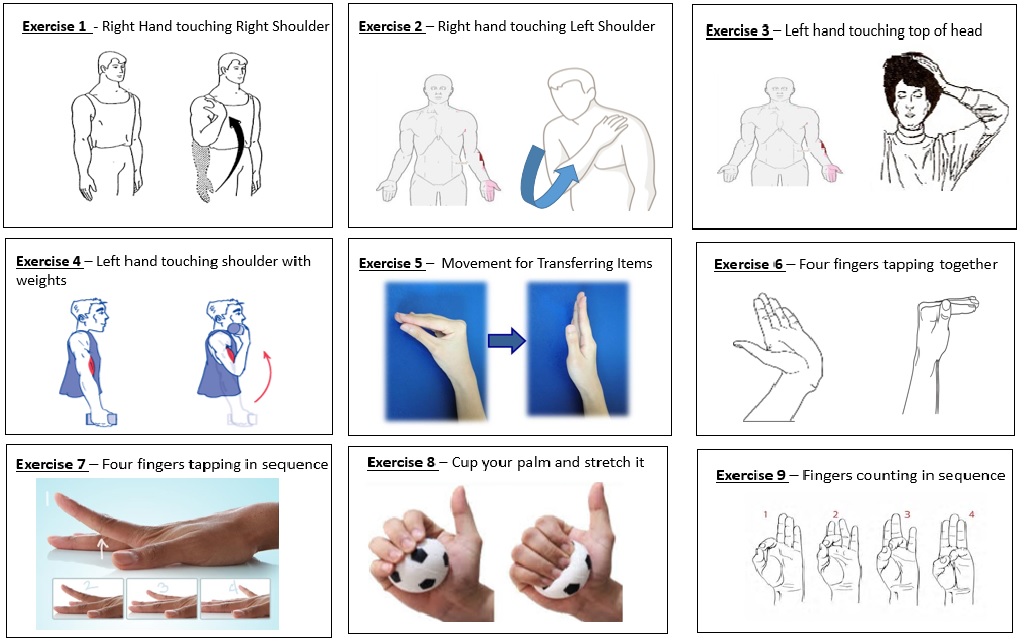
Each activity shall be done 20 times a day, not more than that. If the child has established dominance on the hand, start only with that hand. If no dominance is established, do the exercises for both the hands. Treat this as a movement/massage and not as an exercise.
Exercises for Hand and Elbow Muscles
Exercise 1:
Step 1: Rest your hand next to your Thigh with palms open, with Elbow straight
Step 2: Touch your shoulder with your palm/fingers bending the elbow
Exercise 2:
Step 1: Rest your hand next to your Thigh with palms open, with Elbow straight
Step 2: Touch your alternate shoulder with your palm/fingers bending the elbow
Exercise 3:
Step 1: Rest your hand next to your Thigh with palms open, with Elbow straight
Step 2: Touch your top of the head , with elbow bent.
Exercise 4: (This is a modification to Exercise 1, for clarity i have added it as a separate exercise)
Step 1: Palms carrying 1/4 kg of weight, with Elbow straight down towards the floor
Step 2: Lift the weight by raising your palm with weight up to your shoulders.
Exercise 5:
Twist/roll your palms. i.e. You pick and eat is the movement which is required for which your palm has to face down to pick the food and face up to place the food in your mouth. Give an activity where the food items like channa / dal can be transferred from one place to another.
Exercise for Fingers
Exercise 6:
All 4 fingers tapping together, may on the keyboard
Exercise 7:
All 4 fingers tapping the keyboard one by one.
Exercise 8:
Cup the hand and make it an arch, Stretch it and expand it like squeezing a ball. Given a bigger squeeze ball and not a smaller one that can fit inside the palm.
Exercise 9:
Like fingers counting, all other fingers should touch the wooden finger.This is important for gathering food. You can transfer rice or sand from one bowl to another and slowly increase the distance between the bowls. By performing sensory play/activities with food items such as rice, eating that item becomes easier. This particular exercise is very important, hence even if they do not do it, you do it for them.
All the fingers together, without closing the smallest gap where a bolt/nut can fit in or tooth paste cap can fit in. It is important for writing. You can provide an eraser and ask the kid to rub, which does the same activity.
Stabilization of Body
a) Put them in chairs with Hand Rest, Feet on the Ground, Back rested with support. Some thing to hold on with the other hand. The moment child feels secure, he will co-operate to eat.
b) No distraction during eating, engage in conversing.
c) Don’t use too much of auditory input, like சாப்பிடு சாப்பிடு …it is an sensory overload.
d) Please make your kids to eat with your hand. When the hand touch the food, brain acts and salivation happens in the mouth.
SENSORY COMPONENT
a) Sensory Play with Food. Kids may not eat Rasam, Curd or Kuzhambu, they often play with it or wipe it off in our dress. You try doing the same with them and play with the same food items. Do not use non eatable items for sensory play.
b) Hands in hot water for 2 mins and in cold water for 2 mins..
c) Involve kid in the cooking process, when they observe it will create an interest in them.
d) Keep foods separately while presenting don’t hide and give the foods. Individual taste will go off.
e) Do not give too spicy foods, also at the same time do not give bland foods. Do not travel between two extremes.
ORAL STIMULATION
a) Perform brushing of teeth with Hot water with salt added to it. You can use normal tooth brush or finger brush.
b) Teether can be dipped in warm water and can be used.
c) Blowing through the straw is a beautiful exercise
EMOTIONAL
i) Make eating session relaxed ii) If the full quantity of food is not eaten, leave it. Don’t force the kid to eat the rest or do not give alternate foods like milk or snacks. Let them come back if they fell the sense of hunger. Allow the senses to kick in. iii) Give choices with what is available in home, don’t give options like name and item, i shall buy it from the shop. iv) Make the child to clear the table and bring the plate etc ..
Even if you perform 30% of the strategies we discussed today, you will see changes.
GENERAL POINTERS:
1) DO NOT WORK ON SENSORY INTEGRATION AS AN INDIVIDUAL SKILL, LOOK AT IT HOLISTICALLY..
2) As a parent, when you understand your child, you will know the answers.
3) Do not use Television, Books, Mobile while eating. You are not allowing the senses to integrate.
4) The senses begins to develop in the womb itself and it matures till the age of 8-10. In order to get the vestibular need, pregnant moms are advised to sit in a rocking chair or swing in those days. In normal cases, senses matures till our last day of life.
5) AIM for bigger goals, Don’t look for Activity based goals.
6) We need not excel in everything, but learning and development should happen.
7) Any intervention has to be done for 3 weeks, there is a time to register the new process, it takes time to reach the brain and get transferred. 3 weeks period is the time the body typically requires for adaption of a new intervention.
8) Not giving enough exercises to oral muscles will also impact on the speech.
9) In few marriage functions, people serve too much food with wide varieties in the bana leaf, which can be overwhelming for the kid. You can see kids some times putting their head too close to the food and eating, what they are trying to do is, avoid all other food items from their vision as there are too many and focus on only one item which they are eating. If this is the case, start training your kid by having 2 varieties of food and slowly increase it to the higher number of varieties.
10) Some kids while eating spills food outside the plate and eats the food fallen off outside the plate as well. This could be the reason for not knowing the boundary between Plate and Ground.
11) You have to create a program with Sensory , Motor and Emotional components. It will make the program meaningful.
12) Some child likes sameness in their food, like eating same item for 3 meals in a day. I will encourage parents not to give in to that, as you are curtailing the development of the kid.
13) In children, Gut is the second brain. Research on the Gut with digestive system is an interesting area to explore.
14) Sensory Component and Motor Component goes together. Most of the therapists / therapy centers focuses only on Motor components.
15) Sensory Integration is not afixed, but it is continuous. In sessions conducted by us, the first 10 mins are spent by looking in to the child. The child comes from an external environment, he might have been through arousal activities or may be not. Without
knowing if we made the child perform arousal activities, he will not co-operate on following therapy sessions etc …as there was too much input given on that day than what is required.
16) Give small quantities of food to the kid and let them finish it. It gives them a feel or taste of success which is important.
17) Different colors of foods should be given as it contains micro nutrients. Explore the benefits of capsicum.
18) I do not believe in anything that we do not use in day to day life for sensory exercises. Clay is not required to be used.
On personal questions such as how to connect to the speaker, she said she will get back to us. We can focus on toileting or any other area for the next session if everyone is interested along with details on independent /personal consultation.
My personal feedback:
The speaker Mrs.Lalitha Sridhar clearly knows what she wanted to speak, she brought pointers that needs to be discussed and went with an Agenda and flow, that is logical and understandable. She did manage the constant interruptions by parents very well and was in control of the session. She was perfectly OK to stop the session at any point of time, if there is an overload of information.
She spoke very clearly both in tamil and english. She was able to explain with examples if a term is too technical or complicated for the participant. Also offered to slow down if the participants felt she was rushing or speaking in rapid manner. Since the session duration is of 2:30 hours, she wanted the session to make some sense and meaning to the participants, hence she covered all the key areas that are relevant. She clearly mentioned the time frame is not enough to cover the SI in entirety.
I was bit disappointed on the frequent interruption from participants, the session got side tracked from the flow of the Speaker multiple times. I have seen this with many special parents, where they do not take notes and more keen on asking personal questions specific to their child on a general session meant for a larger audience. This is Probably caused due to parents having children of different age groups, as one section of audience feels certain information is of lesser relevance and divert the speaker to an area of their interest. When you invite some one with intellect and experience for our sake, we are the loosers if speaker was unable to complete the agenda prepared for that day.
Thank Scan for organizing this session and looking forward to upcoming sessions on sensory Integration by Mrs.Lalitha Sridhar, also details on how to approach her for Personal consultation.
Regards,
Saranya and Karthik
karthiksaranyaparents@gmail.com
 Autism Spectrum Disorder - Personal Experiences (Chennai Family)
Thanku so much for sharing so many useful stuffs. Wairing for sensory integration ADL -toilet training. Pls do upload. Thanku
LikeLike
Thank you karthikeyan and saranya, for posting the valuable points. Really appreciate for sparing your time in drafting and making it available to everyone. May god bless you and your family.
LikeLike